The Basilica of Jardín: A Complete Guide to Colombia's Hidden Neo-Gothic Masterpiece
Standing at the northern edge of Jardín's Parque El Libertador, the Basílica Menor de la Inmaculada Concepción commands attention in a way that few buildings in rural Colombia ever do. Its twin spires rise sharply against the green wall of the Andes, its volcanic stone facade carries the somber gravity of a European cathedral, and its 128 stained-glass windows scatter colored light across pews that have seated generations of jardineros since the early twentieth century. For a town of barely fifteen thousand people, tucked into a narrow valley at 1,750 meters above sea level, this is a building that has no business being here — and yet it stands, resolute and magnificent, as the physical and spiritual center of one of Antioquia's most beautiful pueblos.
If you are visiting Jardín, the Basilica is not just a stop on your itinerary. It is the story of the town itself, compressed into stone, glass, and the collective memory of a community that spent more than two decades building it by hand.
The History: A Cathedral Born from Community Faith
The origins of the Basilica reach back to the late nineteenth century. Jardín, founded in 1863, had grown rapidly on the back of coffee cultivation and gold mining. The original parish church — a modest wooden structure — was no longer adequate for a town with such ambitions. The people of Jardín wanted something that would express the depth of their faith and the pride they felt in the community they had carved from the mountains.
Construction began in 1918 under the spiritual leadership of Father Juan Nepomuceno Barrera. The design was entrusted to Giovanni Buscaglione, an Italian Salesian priest and architect who had already made his mark on several churches across Colombia. Buscaglione drew from the European neo-Gothic tradition — pointed arches, ribbed vaults, flying buttresses, soaring verticality — but adapted his vision to the materials and conditions of the Colombian Andes. There would be no imported marble or Bavarian limestone here. The Basilica would be built from the earth it stood upon.
The building campaign lasted from 1918 to approximately 1940, though finishing work continued for a few years beyond. Every block of stone was quarried locally from the hills surrounding Jardín — a grey-green volcanic rock that gives the church its distinctive, almost living color. Without cranes or heavy machinery, the stone was transported by mule and by hand. Farmers donated their labor between harvests. Coffee growers contributed a portion of their earnings. Women organized fundraising bazaars. Children carried smaller stones up the hill. The Basilica was not merely a construction project — it was a generational act of devotion that knitted the entire community together across more than two decades of sustained effort.
There is a persistent local legend — sometimes called the penance story — that Father Barrera required community members who had committed sins to carry heavy stones up to the construction site as a form of atonement. Whether strictly true or embellished by time, the story speaks to the intimate relationship between the Basilica and the daily moral life of the town. The church was not just being built for the people. It was being built by them, in every sense.
The Architect: Giovanni Buscaglione
Giovanni Buscaglione (1874–1941) was a member of the Salesian order who combined his religious vocation with a remarkable talent for architecture. Born in Italy, Buscaglione came to Colombia as part of the Salesian mission and went on to design multiple churches across the country. His style was rooted in European neo-Gothic principles — the emphasis on height, light, and structural honesty — but he demonstrated a consistent ability to translate those principles into local contexts, using regional materials and adapting to the engineering limitations of remote mountain construction.
In Jardín, Buscaglione's design achieves something extraordinary: a building that feels both European in its formal language and deeply Andean in its physical presence. The volcanic stone anchors the Basilica to its landscape. The proportions are ambitious but not grandiose — the building fits the scale of the town square and the surrounding mountains with a sense of inevitability, as though it grew from the valley floor rather than being imposed upon it.
The Architecture: 128 Windows and Volcanic Stone
The Basilica follows a classic Latin cross plan with a nave, two side aisles, transept, and apse. The interior is defined by pointed Gothic arches that draw the eye upward, creating a sensation of height and spiritual aspiration that neo-Gothic architects perfected over centuries.
The Windows
The most celebrated feature of the interior is the collection of 128 stained-glass windows — an extraordinary number for any church, let alone one in a small Andean town. The windows depict biblical scenes, saints, and religious symbols in rich blues, reds, greens, and golds. During the morning hours, when sunlight streams through the eastern windows, the interior is flooded with colored light that moves slowly across the stone floor and wooden pews. This is, without question, one of the most beautiful lighting experiences in any church in Colombia.
The Stone
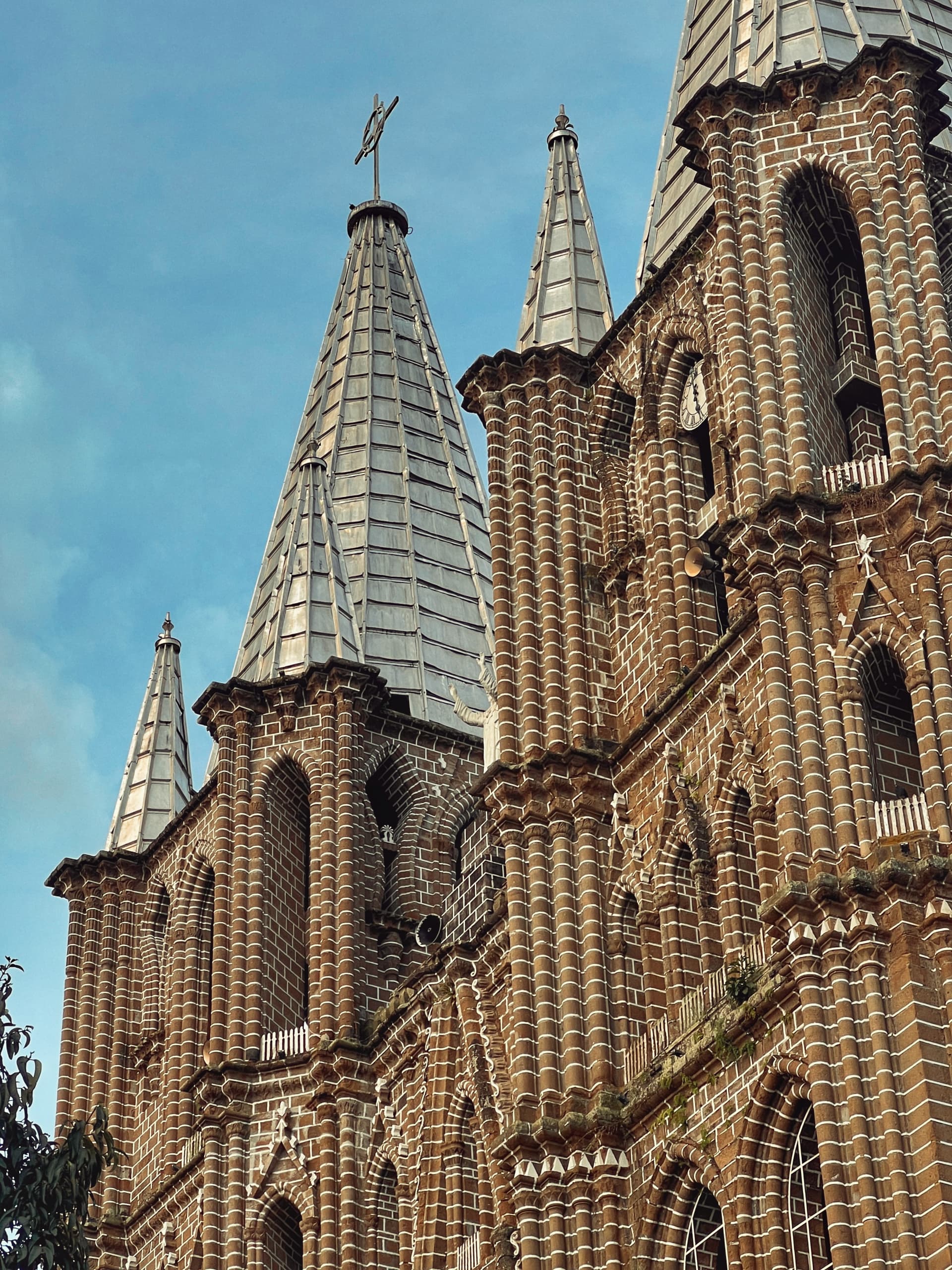
The exterior is constructed entirely of locally quarried volcanic stone, which gives the Basilica its characteristic grey-green hue. Over time, moisture and moss have deepened this color in places, creating subtle variations that make the facade appear almost organic — a quality that photographs rarely capture but that strikes every visitor in person.
The Spires
The twin spires are visible from virtually every approach into Jardín, serving as landmarks for hikers descending from the surrounding mountains and for travelers arriving by road from Andes or Medellín. They are the tallest structures in the valley and give Jardín its unmistakable skyline.
National Monument and Minor Basilica
The building's significance has been formally recognized twice. In 1980, the Colombian government declared the Basilica a National Monument, acknowledging its architectural and historical importance. Then in 2003, the Vatican elevated the church to the status of Minor Basilica — a papal designation that recognizes a church's exceptional spiritual, historical, or architectural significance. This dual recognition places Jardín's church in rare company: a building honored both as a work of national heritage and as a site of international religious importance.
Visiting the Basilica: Practical Tips
Best Time for Photos
The golden hour in the late afternoon (around 4:30–5:30 PM) paints the volcanic stone facade in warm tones that photograph beautifully against the green mountains behind. For interior photography, morning light (8:00–10:00 AM) produces the most dramatic stained-glass effects as sunlight enters through the eastern windows.
Mass Times
The Basilica holds regular masses throughout the week, with the most well-attended services on Sunday mornings. Attending a mass — even if you are not Catholic — offers an authentic glimpse into the spiritual life of the community. Dress modestly out of respect.
What to Notice
- The floor tiles, many of which are original and show the wear of a century of footsteps.
- The wooden pews, crafted by local carpenters from regional hardwoods.
- The acoustic quality of the interior — the vaulted stone ceiling creates a natural reverb that makes hymns and organ music resonate with extraordinary depth.
- The view from the square at night, when the Basilica is illuminated and its spires glow against the dark sky.
Combine Your Visit
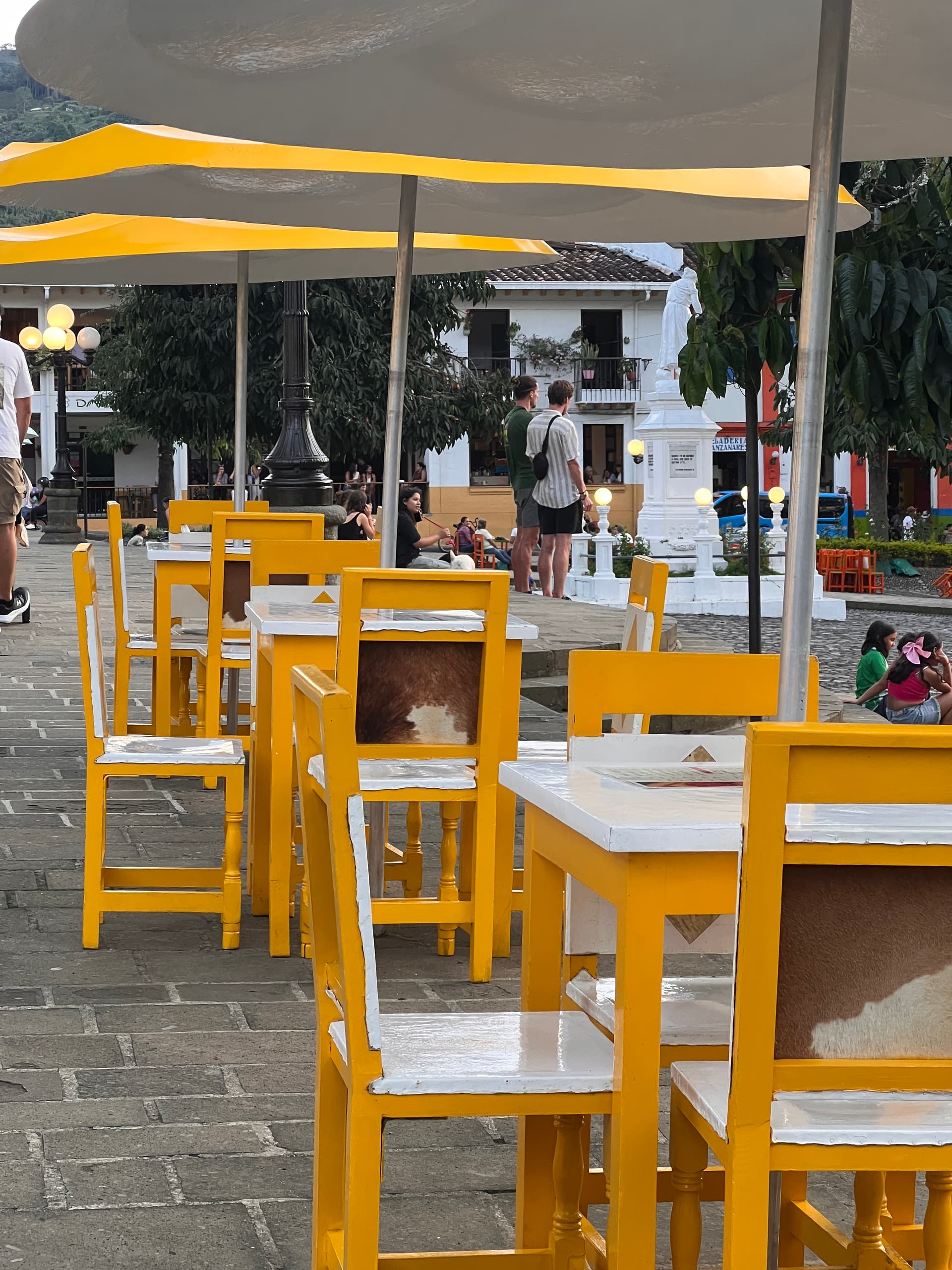
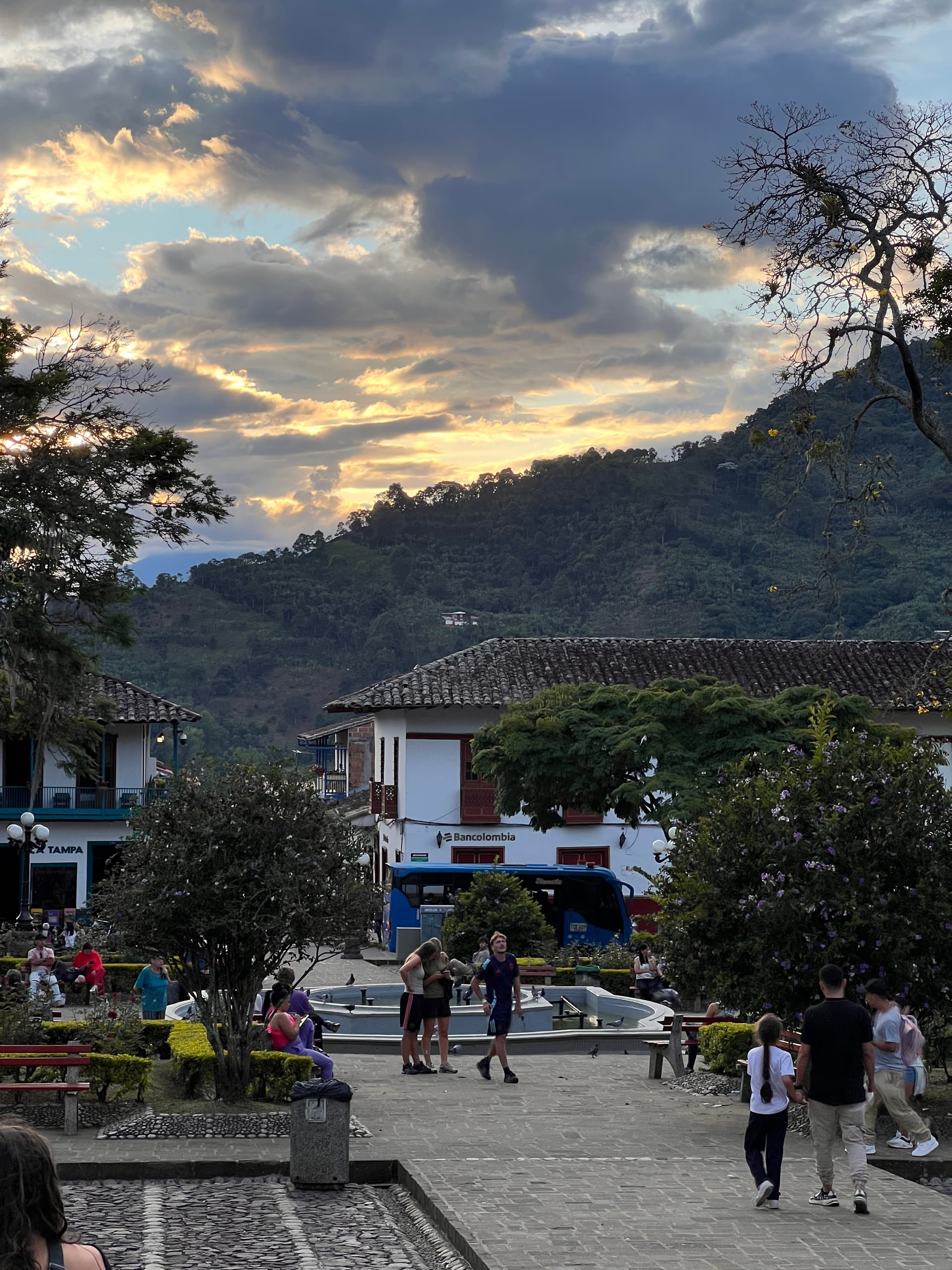
The Basilica sits directly on the Parque El Libertador, the social heart of Jardín. After visiting the church, settle into one of the colorful silla chairs that locals rent on the square, order a tinto or an aguardiente, and watch the world pass by. The square is also the starting point for many of Jardín's best experiences — coffee farm tours, the cable car to La Garrucha, and the route to the Cristo Rey viewpoint.
Why the Basilica Matters
The Basílica de la Inmaculada Concepción is more than a church. It is a testament to what a small community can achieve through collective will, sustained effort, and devotion to something larger than any individual. Every stone in the building was placed by a jardinero — a farmer, a miner, a mother, a child — and that communal DNA lives in the walls to this day.
When you stand in the Parque El Libertador and look up at the twin spires cutting into the Andean sky, you are not just seeing architecture. You are seeing the character of an entire town, expressed in volcanic stone and colored glass. That is what makes Jardín's Basilica one of the most remarkable buildings in Colombia — not its size, but its soul.
Where to Stay in Jardín
Isla de Pascua is a social hostel with a swimming pool, coworking space with 50 Mbps WiFi, and a common area that makes it easy to meet other travelers. It's steps from the main square and the best base for exploring everything Jardín has to offer.
Learn more about Isla de Pascua →