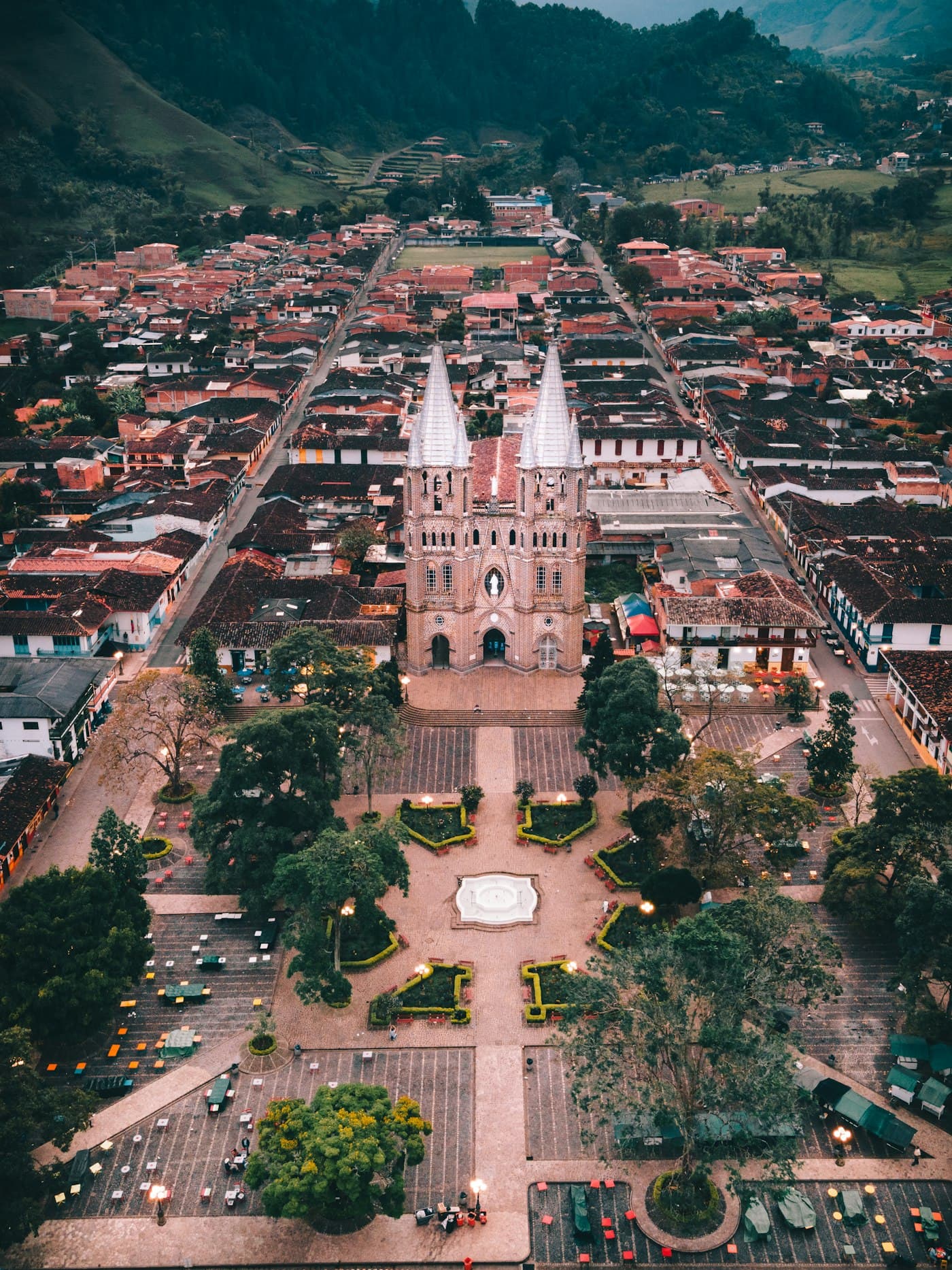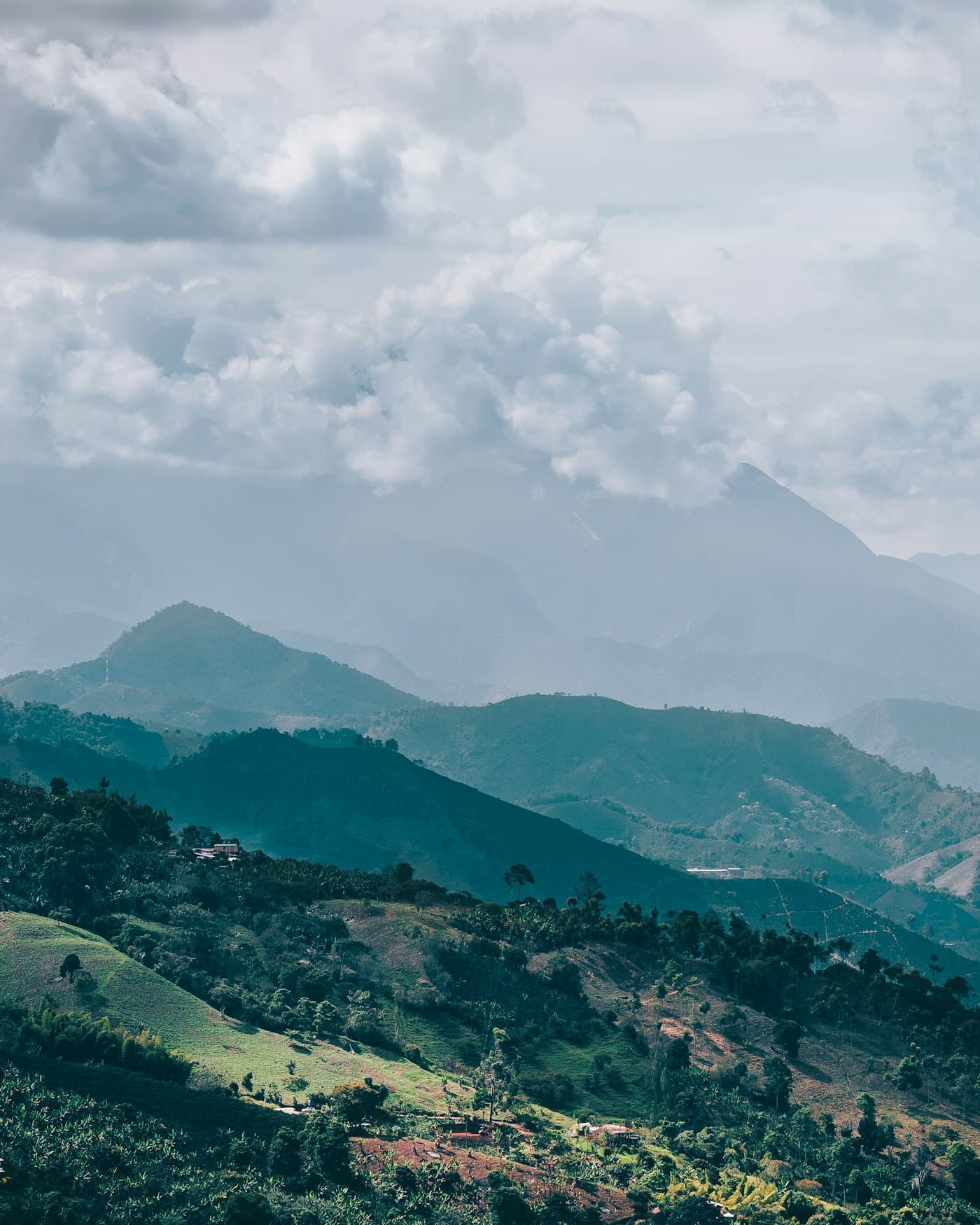
There is a moment, somewhere between the last steep switchback and the clearing where the Cristo Rey statue stands with arms outstretched against the sky, when the world below you opens like a book. The red rooftops of Jardín appear first, clustered tight around the plaza like a painter's study in terracotta and white. Then the basilica rises into view — its twin Gothic spires reaching upward as if trying to meet you at your altitude. Beyond the town, the Andes unfold in every direction: ridge after green ridge, coffee farms cascading down hillsides in perfect diagonal rows, the silver thread of the Río Jardín winding through the valley floor, and clouds that drift through the passes like slow-moving ships. You stand there, breathing hard from the climb, and the entirety of Jardín — its beauty, its geography, its reason for existing in this precise fold of the mountains — is laid out before you in a single, sweeping panorama.
This is Cristo Rey. And this is why you came.
A Hilltop with History
Every Colombian pueblo has its mirador — a high point, often crowned with a religious statue, that gives residents and visitors alike a God's-eye view of the world below. It is a tradition rooted in both faith and geography, a recognition that in a land of mountains, the highest point is always the most sacred.
Jardín's Cristo Rey follows this tradition. The statue — a concrete figure of Christ with arms extended in blessing — was erected on the hilltop east of town in the mid-twentieth century, during a period when communities across Colombia, inspired by the famous Cristo Redentor in Rio de Janeiro, placed their own Christ figures on prominent peaks. The Jardín version is modest in scale compared to its Brazilian cousin, standing perhaps four meters tall on a simple pedestal, but its placement is inspired. The hill it occupies is the natural balcony of the town, the one point from which the entire valley reveals itself. Locals call it simply "el Cristo" or "el mirador," and for generations it has served as a place of pilgrimage, morning exercise, courtship, contemplation, and — increasingly — one of the most photographed viewpoints in southwest Antioquia.
The path to the summit is older than the statue itself. Long before Christ was placed at the top, the hill was a lookout used by the indigenous Emberá-Chamí people who inhabited this valley, and later by the Antioquian settlers who founded Jardín in 1863. The trail you walk today is the same route those early settlers climbed to survey their new home, to watch for approaching travelers, to take stock of the seasons by the color of the valley below. When you hike Cristo Rey, you are walking a path worn by centuries of human curiosity about what lies beyond the next ridge.
Trail Overview at a Glance
Before we walk the trail step by step, here are the essential numbers:
Distance: Approximately 2.5 kilometers from the plaza to the summit (one way), with about 1.5 km of that being the actual trail after you leave the paved streets
Elevation gain: Roughly 300 meters (985 feet) from town to summit
Starting elevation: Jardín sits at approximately 1,750 meters (5,740 feet) above sea level
Summit elevation: Approximately 2,050 meters (6,725 feet)
Time: 45 minutes to 1 hour uphill at a moderate pace, 30–40 minutes descending
Difficulty: Moderate. The trail is steep in sections but never technical. No scrambling, no exposed ridges, no ropes. If you can climb stairs for 45 minutes, you can do this hike.
Cost: Completely free. No entrance fee, no ticket, no guide required.
Hours: Open at all times — there are no gates, no closing hours. The trail is accessible 24 hours a day, which makes sunrise hikes possible.
Trail surface: A mix of dirt path, stone steps (in the steepest sections), and short paved stretches near the base. During rainy season, expect mud.
Getting to the Trailhead from the Plaza
The beauty of Cristo Rey is that it starts from the heart of Jardín itself. There is no need for a jeep, a guide, or any special transport. You simply walk.
From Jardín's main plaza — the Parque Principal, with its famous colorful chairs and the Basilica of the Immaculate Conception presiding over one end — face east. You will be looking uphill, toward the mountains that form the valley's eastern wall. The Cristo Rey statue is visible from many points in town on clear days, a small white figure on the ridgeline, giving you a natural beacon to walk toward.
Step 1: Leave the plaza heading east. Walk along Calle 10 (also called Calle del Comercio by locals), passing shops, cafés, and the occasional tienda selling aguardiente and snacks. After two blocks, the commercial district gives way to residential streets.
Step 2: Follow the signs uphill. Jardín has improved its signage in recent years, and you will find small painted signs or arrows on walls reading "Cristo Rey" or "Mirador" at most intersections where you might hesitate. The general rule is simple: keep going uphill. If the road goes up, you are probably going the right way.
Step 3: Pass through the residential neighborhoods. The route takes you through quiet streets lined with traditional Antioquian houses — whitewashed walls, painted window frames in blue or green, balconies dripping with bougainvillea and geraniums. Dogs sleep in doorways. Abuelas watch from rocking chairs. Children kick soccer balls against walls. This section takes about 10–15 minutes and is part of the charm — you see the real, lived-in Jardín that tourists in the plaza never encounter.
Step 4: Reach the trailhead. The paved road ends and the dirt trail begins at the edge of town. You will know it when you see it: the houses thin out, the pavement stops, and a well-worn path heads uphill into the vegetation. There is usually a faded sign here, sometimes a painted rock. From the plaza to this point is roughly one kilometer and 15 minutes of walking.
By moto-taxi: If you want to skip the walk through town, you can hire a moto-taxi from the plaza to the trailhead for approximately 5,000–8,000 COP. Simply say "Cristo Rey" and the driver will know. This saves about 10 minutes but costs you the pleasant walk through the residential streets.
The Trail: Step by Step
Section 1 — The Lower Trail (Trailhead to the Forest Edge)
Distance: ~500 meters | Time: ~10 minutes | Gradient: Gentle to moderate
From the trailhead, the path follows a wide dirt track that winds gently uphill through the final fincas on the outskirts of town. You will pass small farms with chickens scratching in the dust, plots of plantain and yuca, and the occasional cow watching you with benign indifference from behind a wire fence. The vegetation here is open — pasture grass, scattered fruit trees, hedgerows of hibiscus — and the views behind you are already beginning to open up. If you turn around, you can see the rooftops of Jardín below, with the basilica spires rising above them.
The gradient here is gentle, a warm-up for what is to come. Your breathing barely changes. The morning air smells of damp earth and woodsmoke from kitchen fires. You might hear roosters crowing, even at mid-morning — in Jardín, roosters observe no schedule.
Local dogs often appear on this section, trotting alongside you with wagging tails and an air of purpose, as if they have appointed themselves your guides. They are friendly, harmless, and will usually turn back once the trail gets steep. Let them accompany you — they know the path better than you do.
Section 2 — The Climb (Forest Edge to the Upper Ridge)
Distance: ~700 meters | Time: ~20–25 minutes | Gradient: Steep
This is the heart of the hike, and where you earn your view.
The trail narrows and steepens significantly as you enter a zone of dense secondary forest. The canopy closes overhead, providing welcome shade. The path becomes a series of switchbacks — short, steep ramps connected by turns — that zigzag up the hillside. In the steepest sections, stone steps have been laid by hand, some rough-hewn and ancient-looking, others more recently installed. These steps are a blessing on the way up and a knee-saver on the way down.
The forest around you is alive with sound. Birds call from the canopy — listen for the melodic song of the mirla (great thrush), the rapid-fire tapping of woodpeckers, and the sharp whistle of the barranquero (motmot) that is Jardín's unofficial avian mascot. If you pause and stand still, you might spot tanagers moving through the mid-story in flashes of blue and yellow, or a hummingbird hovering at a flowering bush along the trail edge.
The air temperature drops noticeably in the forest. If you started warm from the walk through town, you will welcome the cool. If you are hiking before dawn for sunrise, you may want a light layer here.
About halfway up this section, there is an informal rest stop — a natural clearing where the trail levels briefly and a fallen tree provides a seat. Many hikers pause here to catch their breath. Through a gap in the trees, you get a partial preview of the view: a slice of valley, a strip of rooftops, the suggestion of what awaits above. It is a motivating glimpse. The summit is fifteen minutes away.
The final push from this rest stop is the steepest part of the entire hike. The trail ascends directly, with stone steps that feel like a staircase carved into the mountain. Your calves will know they are working. Your lungs will remind you that you are at nearly 2,000 meters of altitude. But it is short — perhaps ten minutes of sustained effort — and then the trees begin to thin, the sky opens above you, and you know you are close.
Section 3 — The Summit Approach
Distance: ~300 meters | Time: ~10 minutes | Gradient: Moderate, then flat
The trail emerges from the forest and crosses a final stretch of open hillside — low grass, a few scattered shrubs, exposed rock. The world expands around you. The valley drops away on your left. The ridgeline rises to your right. And ahead, silhouetted against the sky, the Cristo Rey statue stands with arms open, as if welcoming you personally.
The final approach is a gradual incline across the hilltop to the concrete platform where the statue stands. There are benches here, a low railing, and enough space for perhaps twenty people to spread out comfortably. On weekday mornings, you might have it entirely to yourself. On weekends, you may share it with local families, fitness enthusiasts who jog the trail daily, and fellow travelers clutching cameras.
You have arrived. Total time from the plaza: 45 minutes to one hour. Total time from the trailhead: 30 to 45 minutes. And the view — the view makes every step worth it.
The Panoramic View: What You Can See
The Cristo Rey viewpoint offers a true 360-degree panorama. Walk around the platform and you will see a different landscape in every direction.
Looking North and Northeast — The Town of Jardín
This is the postcard view, the one you came for. Jardín is spread below you like a scale model, its grid of streets perfectly visible, the red clay tile rooftops of traditional Antioquian architecture forming a warm mosaic against the green hillsides. At the center, the Basilica of the Immaculate Conception dominates — its gray stone facade and twin spires unmistakable, the largest and most ornate church in any pueblo of this size in Colombia. Around it, the Parque Principal is a rectangle of green, and on clear days you can make out the famous colored sillas (chairs) that line its edges.
Beyond the town, the valley opens northward along the Río Jardín. The river appears as a silver-green ribbon curving through pastures and farms, its course visible for several kilometers before it disappears around a bend in the mountains.
Looking East — The Andean Ridgeline
To the east, the mountains rise in a wall of green that forms the boundary of Jardín's valley. These are the foothills of the Western Cordillera of the Colombian Andes, and they stack up in layers of diminishing color — vivid green in the foreground, darker green in the middle distance, blue-gray on the horizon. On exceptionally clear mornings, you can count five or six distinct ridgelines receding into the distance, each one higher and hazier than the last.
The eastern slopes are covered in a mix of cloud forest and coffee farms. You can pick out the coffee fincas by their distinctive appearance: orderly rows of dark green coffee plants following the contours of the hillside, interspersed with taller shade trees — guamo, carbonero, and nogal — that protect the coffee from direct sun.
Looking South — Into the Cloud Forest
The southern view is the wildest. The mountains deepen and darken, the forest grows thicker, and the landscape takes on a wilder, more primordial character. This is the direction of Cueva del Esplendor, the famous waterfall cave that is Jardín's other iconic attraction, hidden somewhere in those green folds. On clear mornings, you can trace the ridgeline that leads toward it, imagining the trail that winds through cloud forest to reach it.
The cloud forest here is one of the most biodiverse ecosystems in the Americas. What looks like a uniform green carpet from this altitude actually contains hundreds of tree species, thousands of epiphytes — orchids, bromeliads, ferns — and a density of birdlife that draws ornithologists from around the world.
Looking West — The Coffee Landscape
To the west, the terrain softens into the rolling hills that characterize Colombia's coffee-growing region. This is the cultural landscape that UNESCO recognized as a World Heritage site — not for a single monument, but for the living tradition of coffee cultivation that has shaped these mountains for over a century.
From Cristo Rey, the coffee farms are visible as a patchwork of greens: the dark, glossy green of coffee plants in neat rows, the lighter green of banana and plantain plants that provide shade, the silver-green of guadua bamboo along the creeks, and the bright emerald of pastures where cattle graze. Small farmhouses dot the hillsides — white walls, colored doors, tin roofs glinting in the sun.
The Sunrise Experience
If you do one thing during your time in Jardín that requires setting an alarm, make it a sunrise hike to Cristo Rey.
Jardín sits near the equator, which means the sun rises between approximately 5:45 and 6:15 AM year-round, with minimal seasonal variation. The eastern orientation of the Cristo Rey viewpoint makes it ideal for sunrise watching — you are facing directly into the rising sun, with the town and valley illuminated from behind you and below.
What a Sunrise Looks Like from Cristo Rey
You arrive in darkness, the trail navigated by headlamp, the forest sounds amplified by the absence of sight. The last ten minutes of the climb are done in the gray half-light of nautical twilight, the sky transitioning from black to deep blue to the faintest suggestion of color on the eastern horizon.
At the summit, you settle onto a bench or lean against the railing. The valley below is a pool of shadow and mist. Jardín's streetlights glow faintly — tiny amber dots in the darkness, giving shape to the town's grid. The basilica is a dark silhouette. The mountains are black outlines against the lightening sky.
Then the color begins. The eastern horizon turns from blue to lavender to rose to gold, and the first direct sunlight strikes the summit where you stand — warm on your face, sudden and vivid after the cool darkness of the trail. Below you, the light descends like a curtain being pulled back. The upper rooftops catch it first, glowing orange. Then it slides down the hillsides, illuminating the coffee farms, the river, the valley floor. Mist that fills the hollows and low points catches the light and turns gold, then slowly dissolves as the sun gains strength.
The basilica spires are the last part of town to catch the light, and when they do — when the gray stone suddenly flares warm in the morning sun — it is one of those moments that lodges in your memory permanently. The whole town is awake now, lit golden, alive. You hear the first sounds drifting up from below: a motorcycle starting, a dog barking, the distant clang of the church bell marking the hour.
The entire sequence — from first color to full daylight — takes about twenty minutes. You will not want to leave.
Sunrise Logistics
Timing: Check the exact sunrise time for your dates (a simple phone search for "sunrise Jardín Colombia" will give it). Plan to be at the summit 15–20 minutes before sunrise to watch the full show. This means leaving your accommodation roughly 50–60 minutes before sunrise.
What to bring: A headlamp (essential — the trail is dark and a phone flashlight is awkward), a warm layer (mornings at 2,000 meters before sunrise are chilly, around 12–15 degrees Celsius), water, and your camera.
Safety: The trail is well-worn and easy to follow even in the dark, but go slowly on the steep stone steps. If it rained the night before, the stone can be slippery. Give yourself extra time rather than rushing in low light.
Company: You will often have the summit to yourself at sunrise on weekdays. On weekends, you might share it with a few local joggers or other travelers. Either way, the atmosphere is quiet and contemplative — people who hike to see the sunrise are not the type to shatter the silence.
The Sunset Alternative
While sunrise is the crown jewel, a late afternoon visit has its own charm. The sun sets to the west, behind and above you as you face the town, which means you will not see a dramatic sunset directly. But the golden hour light — that warm, angled illumination that photographers prize — paints the valley and town in honey-colored tones that are beautiful in a different way than the sunrise.
Sunset visits are also warmer and more social. You are more likely to encounter families, couples, and groups of friends who have climbed up to enjoy the evening view. The mood is relaxed and festive rather than contemplative.
Important: If you visit for sunset, start your descent while there is still daylight. The trail is not lit, and descending the steep stone steps in full darkness is genuinely risky. Plan to leave the summit no later than 30 minutes before the sun fully sets.
What to Bring
The Cristo Rey hike is short and non-technical, but a few items make the experience significantly better:
- Water: At least 500 ml, more if it is a warm day. The climb is steep and you will sweat, even in cool morning air.
- Headlamp: Essential for sunrise hikes. A dedicated headlamp frees your hands for balance on the steep sections and is far more practical than holding your phone.
- Camera or phone: This is arguably the single best photography location in Jardín. Bring whatever you shoot with and make sure it is charged.
- Light warm layer: For sunrise hikes. A fleece, a light jacket, or even a flannel shirt is enough. You will warm up on the climb but cool quickly at the exposed summit.
- Good shoes: The trail is not technical, but the stone steps can be slippery when wet, and the dirt sections become muddy in rain. Hiking shoes or trail runners with good grip are ideal. Flip-flops are genuinely dangerous on the descent. Sneakers work on dry days.
- Sunscreen and hat: For any visit after sunrise. The summit is fully exposed with no shade, and the equatorial sun at 2,000 meters is strong.
- Snack: A granola bar, some fruit, a piece of pan de bono from a bakery in the plaza. There is something deeply satisfying about eating a simple breakfast while watching the sun light up a valley.
- Insect repellent: Mosquitoes are rare at the summit but can be present in the forested middle section, especially in the wet season.
You do not need a full daypack. A small bag, a jacket with deep pockets, or even a tote bag will carry everything you need.
Photography Tips
Cristo Rey is one of the premier photography spots in the entire southwest Antioquia region. Here is how to get the best shots.
Sunrise golden hour: The fifteen minutes after sunrise produces the most dramatic light. Shoot toward the town and valley — the low-angle light creates long shadows, warm tones, and that ethereal quality of mist catching sunlight. Use HDR mode on a phone or bracket exposures on a camera to handle the high contrast between the bright sky and shadowed valley.
The classic composition: Stand on the northeast side of the platform. Frame the Basilica as your central subject, with the plaza and town spreading out around it, the valley opening behind, and the mountains rising on either side. This is the "hero shot" of Jardín — the image that captures the town's essence in a single frame.
Include the statue: For a distinctive Cristo Rey shot, position yourself to include the statue's outstretched arms in the foreground, with the valley panorama beyond. Shoot from a low angle to make the statue more imposing against the sky.
Panoramic mode: The summit is tailor-made for panoramic photos. The 360-degree view is too wide for any single frame, but a slow, steady panoramic sweep captures the full scope. Start facing south and sweep north for the most dramatic light gradient at sunrise.
Telephoto details: If you have a telephoto lens or a phone with good zoom, pick out details in the valley: the basilica's rose window, the colored chairs in the plaza, the precise rows of a coffee farm, a fisherman on the river. These detail shots complement the wide panoramas.
Drone photography: Drones can be flown from the summit, and the aerial perspective adds another dimension — the Cristo Rey statue from above, with the town and valley spreading below it. Fly early on weekday mornings for uninterrupted access. Be respectful of other visitors and keep the noise brief.
Phone photography: A modern smartphone is more than sufficient for stunning images here. The views do the heavy lifting. Use portrait mode for the statue against the sky, panorama mode for the full vista, and night mode if you arrive before dawn and want to capture the predawn blue hour.
Difficulty and Fitness
Cristo Rey is classified as moderate, but that assessment deserves some nuance.
Who can do it: Anyone with reasonable cardiovascular fitness and no serious knee or joint problems. If you can walk uphill for 45 minutes without stopping, you will be fine. If you normally need to stop and rest, that is also fine — there are natural rest points and the trail is forgiving. Children as young as six or seven regularly complete it. Older adults in good health hike it routinely. It is a community trail, not a wilderness expedition.
Who might struggle: The elevation (starting at ~1,750 meters) affects some visitors, particularly those arriving from sea level. If you arrived in Jardín within the last 24 hours from a low-altitude city, you may feel the altitude on the steeper sections — slightly more breathless than usual, slightly slower. This is normal and not dangerous. Simply go at your own pace and rest when needed.
The steepest section — the stone staircase in Section 2 — is genuinely steep, with a gradient that might feel like 30–35 degrees in places. This lasts about 10 minutes. It is a cardiovascular challenge, not a technical one. There is nothing to fear, only effort to give.
Coming down: The descent is harder on the knees than the ascent is on the lungs. The stone steps that helped you going up become something to negotiate carefully going down, especially if wet. Trekking poles help if you have problematic knees, but most people manage without them.
Safety and Weather
Weather patterns: Jardín's weather follows a fairly predictable pattern. Mornings are generally clear, with clouds building through the afternoon and rain most likely in the late afternoon or evening (especially during the wet seasons of April–May and September–November). This pattern favors sunrise and morning hikes, when skies are clearest and rain is least likely.
Rain and the trail: A heavy rain transforms the middle section of the trail. The dirt path becomes slick clay. The stone steps become greasy. Puddles form in the switchbacks. If it rained heavily the night before, give the trail an hour or two to drain before attempting it. If rain catches you on the trail, slow down dramatically on the descent — a slip on wet stone steps is the most realistic hazard of this hike.
Lightning: Jardín occasionally experiences thunderstorms, and the Cristo Rey summit, being an exposed high point with a metal-reinforced concrete statue, is exactly where you do not want to be in a lightning storm. If you see dark clouds building or hear thunder, descend immediately. This is the one genuine safety concern.
Temperature: Summit temperatures range from about 12 degrees Celsius (54 Fahrenheit) at dawn to 22 degrees (72 Fahrenheit) at midday. The change is significant. Dress in layers.
Other people: Cristo Rey is well-trafficked by locals and tourists alike. It is not a remote or isolated trail. You are unlikely to ever be truly alone on it, which adds inherent safety. Jardín is one of the safest towns in Colombia, and the trail reflects that.
Dogs: Friendly local dogs frequently join hikers on the trail. They are harmless companions, though they can be startling in the dark during pre-dawn ascents. They will usually turn back once you reach the steep section.
No facilities: There are no bathrooms, no water taps, no vendors, and no shelters at the summit or along the trail. Everything you need must be carried with you. Handle necessities before you leave town.
Combining Cristo Rey with Other Experiences
The Cristo Rey hike takes only one to two hours round trip, which makes it an ideal opening act for a full day of exploration. Here are the best combinations:
The Perfect Morning — Sunrise + Coffee Tour: Wake early, hike Cristo Rey for sunrise, descend to town for breakfast at one of the bakeries on the plaza, then join a mid-morning coffee farm tour. You will have seen the coffee farms from above at sunrise and will now walk among them at ground level. This combination fills a morning with two of Jardín's essential experiences.
Heights Double — Cristo Rey + La Garrucha: After descending from Cristo Rey, walk to La Garrucha, the cable car that crosses the valley. You get two completely different elevated perspectives of Jardín — one earned on foot, the other gliding through the air. Both before lunch.
The Orientation Day — Cristo Rey + Plaza Afternoon: If this is your first day in Jardín, start with Cristo Rey in the morning to see the town from above and understand its geography. Then spend the afternoon at ground level — exploring the plaza, visiting the basilica, wandering the side streets, drinking coffee. You will appreciate the town differently having seen it from the hilltop first.
The Nature Combo — Cristo Rey + Birdwatching: Carry binoculars on your Cristo Rey hike. The forested middle section of the trail passes through habitat where you may spot tanagers, motmots, woodpeckers, and hummingbirds. After descending, head to the Gallito de Roca reserve in the afternoon for dedicated birdwatching. A full day immersed in Jardín's natural world.
The Endurance Day — Cristo Rey + Cueva del Esplendor: For fit hikers who want a challenge, start with a sunrise at Cristo Rey, descend, have a substantial breakfast, then embark on the longer hike to Cueva del Esplendor. This is a full day of hiking but immensely rewarding — you bookend the day with Jardín's two most iconic viewpoints.
For a complete day-by-day plan, see our 3-day Jardín itinerary.
What the Locals Know
Ask any Jardinero about Cristo Rey and they will tell you it is not just a tourist attraction — it is the town's morning gym, its meditation room, its thinking place. Locals hike Cristo Rey the way city people go for a jog: routinely, almost ritually, as part of the rhythm of life.
On any given morning, you will see abuelitas in their seventies climbing steadily in house slippers, teenagers racing each other to the top, couples walking hand in hand, farmers taking a break from field work to stretch their legs. The trail is a commons, a shared space that belongs to everyone.
This means you are not a tourist doing a tourist activity when you hike Cristo Rey — you are participating in something the community does. You are walking their path, sharing their view, breathing their air. And that, perhaps, is the deepest reason to make the climb.
Final Thoughts: The View That Explains Everything
There is a reason that travel writers and guidebooks repeatedly call Cristo Rey the best short hike in Jardín. It is not because the trail itself is exceptional — it is a straightforward dirt path up a hill. It is not because the statue is remarkable — it is a modest concrete Christ. It is because the view from the top is the single best summary of what makes Jardín extraordinary.
Standing at Cristo Rey, you see it all at once: the Andes in their staggering scale, the cloud forest in its green density, the coffee farms in their cultivated beauty, the town in its architectural charm, the river in its slow winding, the sky in its equatorial vastness. You see the geology that created this valley, the agriculture that sustains it, the culture that animates it. You see why people came here 160 years ago to found a town, and why people keep coming today to experience it.
It is 45 minutes of effort for a lifetime of understanding. Set your alarm, lace up your shoes, and walk to the top. Jardín is waiting to show you everything.