Why Jardín's Doors Are Famous
There is a moment, early in any visit to Jardín, when you stop walking and simply stand in front of a door. Not because someone is about to open it, and not because you need to go inside. You stop because the door itself — its color, its weight, the hand-carved details in its wooden panels, the way the morning light catches the grain — is so beautiful that it demands a pause. And then you look up and notice the balcony overhead, painted in a contrasting shade of teal or burnt orange, and the clay tiles on the roof above that, and the potted orchid hanging from a wrought-iron bracket, and you realize that in Jardín, the architecture is not a backdrop to the experience. It is the experience.
Jardín's colorful doors have become one of the most photographed subjects in all of Colombia. They appear on the covers of travel magazines, across Instagram feeds, and in tourism campaigns for the Antioquia department. But the doors are not decorative afterthoughts designed to attract visitors. They are the living expression of a town that has maintained its colonial architectural heritage with extraordinary consistency for more than 160 years. Every painted facade, every carved wooden panel, every wrought-iron hinge tells a story about the families who built these houses, the artisans who shaped them, and the community that has collectively decided, generation after generation, that beauty matters.
This is a walking tour of those doors, those facades, and the streets that connect them. It requires no guide, no ticket, and no particular schedule — only comfortable shoes and a willingness to look closely.
A Town Frozen in Time: The Colonial Heritage
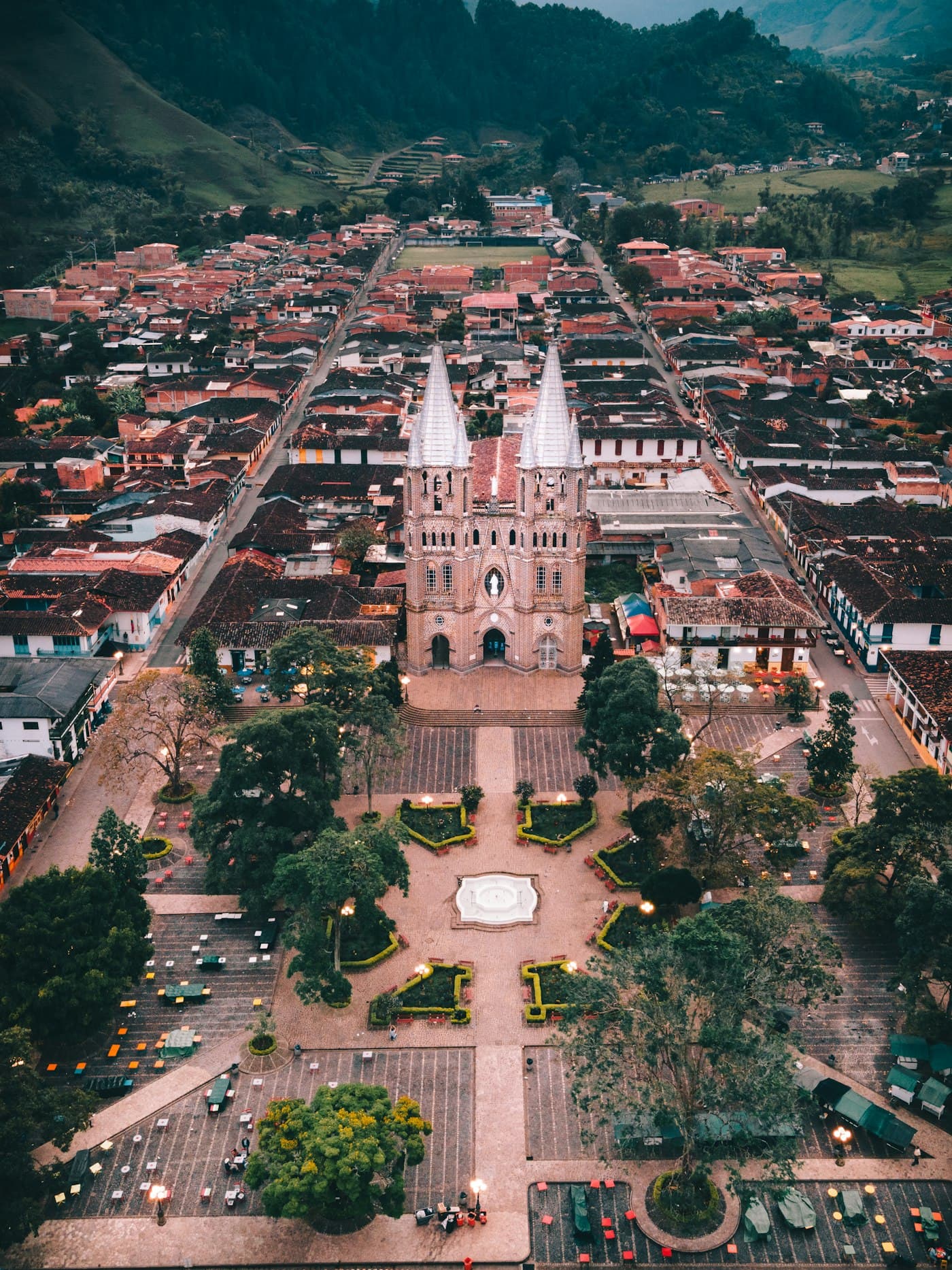
Jardín was founded in 1863 during the great Antioquian colonization, when families from Medellín, Rionegro, and Santa Fe de Antioquia pushed into the mountains of southwestern Antioquia seeking fertile land and new beginnings. The town they built followed the classic Spanish colonial grid: a central plaza anchored by a church, with streets radiating outward in straight lines, each block filled with single- and two-story houses constructed from the materials the mountains provided.
What makes Jardín exceptional is not that it was built this way — dozens of Antioquian towns share the same origin. What makes it exceptional is that it never changed. While other pueblos tore down their colonial buildings during the modernization waves of the 1960s and 1970s, replacing wooden balconies with concrete balustrades and clay tile roofs with corrugated metal, Jardín kept everything. The combination of geographic isolation — the town sits in a narrow valley accessible only by winding mountain roads — relative economic modesty, and deep community pride meant that the original fabric of the town survived intact.
In 1985, the Colombian government recognized what Jardín's residents had long known: the town's architectural ensemble was a treasure of national significance. Jardín received its designation as a Patrimonio Histórico Nacional (National Historic Heritage) site, placing it under legal protection and ensuring that new construction and renovations within the historic core must respect the original architectural character. Later, the town was included in Colombia's network of Pueblos Patrimonio (Heritage Towns), a program that supports the preservation and promotion of the country's most culturally significant municipalities.
This dual designation means that when you walk through Jardín today, you are not looking at a reconstruction. You are looking at the real thing — houses built in the nineteenth and early twentieth centuries, maintained and repainted and loved into the present day. The doors you photograph are, in many cases, the same doors that were hung more than a century ago.
The Walking Tour: Street by Street
Starting Point: Parque El Libertador (The Main Plaza)
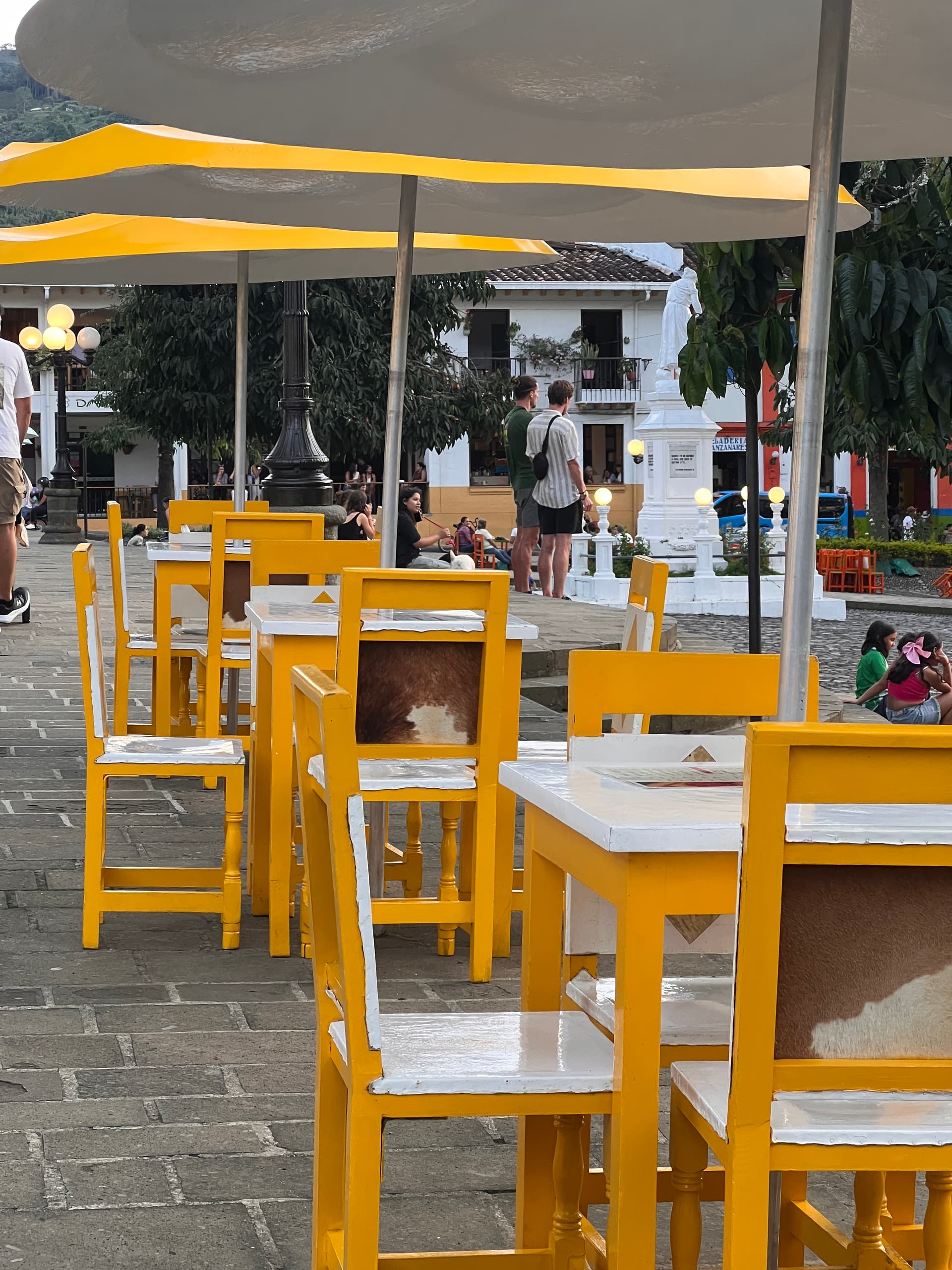
Every walk through Jardín begins where the town itself begins — in the main square. Parque El Libertador is one of the most beautiful plazas in Colombia, and its most distinctive feature is immediately apparent: hundreds of brightly painted wooden chairs arranged across the square, each one hand-decorated with flowers, birds, geometric patterns, and scenes from daily life in Jardín.
These are the famous sillas de Jardín — the chairs of Jardín — and they are a folk art tradition found nowhere else in Colombia. The chairs are not antiques locked behind velvet ropes. They are functional public seating, free for anyone to use. Locals sit in them every evening to drink coffee, gossip, watch the world go by, and occasionally argue about football. The chairs are repainted regularly, each one a small canvas expressing the personality of the artisan who decorated it. Some feature the Gallito de Roca (Cock-of-the-Rock), Jardín's emblematic bird. Others depict coffee cherries, the Basilica, mountain landscapes, or abstract swirls of color that seem to capture the energy of the town itself.
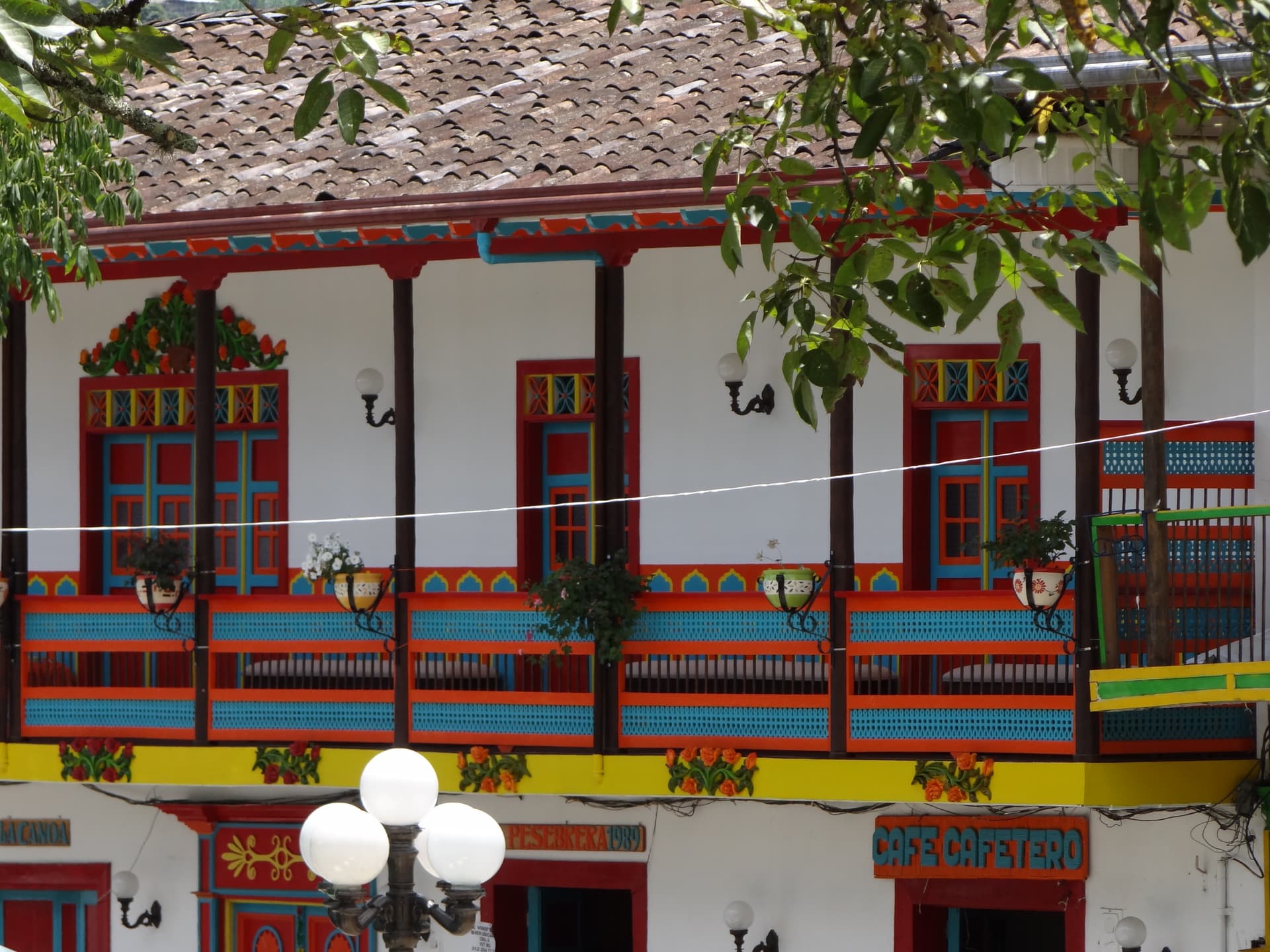
Sit in one. Take your time. From any chair in the plaza, you can already see the architectural story that unfolds across the rest of the walk. The buildings lining all four sides of the square are two-story colonial structures with continuous wooden balconies, each painted in a different color — saffron yellow beside sage green beside coral pink beside sky blue. The ground-floor level features shops, cafes, and restaurants behind tall wooden doors, some propped open to reveal the cool tile floors within. The upper balconies are residential, often hung with flower boxes and laundry drying in the mountain air.
And at the north end of the plaza, rising with solemn grandeur above it all, stands the neo-Gothic Basílica Menor de la Inmaculada Concepción, its grey volcanic stone a dramatic counterpoint to the riot of color below. The Basilica took 24 years to build, from 1918 to 1942, every stone quarried from the surrounding hills and carried by hand and mule. It is the anchor of the entire architectural composition — the monochrome gravity that makes the colors around it sing.
Calle Real: The Main Artery
From the southwest corner of the plaza, walk along Calle Real — the main street that has connected the plaza to the town's outer neighborhoods since Jardín's founding. This is the most photographed street in town, and for good reason.
Calle Real is a study in rhythm and variation. The houses on both sides follow the same basic form — two stories, continuous balconies, tile roofs — but no two are identical in color or detail. One facade might be painted a deep turquoise with cream-colored trim around the windows and a door of carved dark wood. The next might be canary yellow with forest-green shutters and a door painted the vivid orange of a ripe mandarin. Then comes a house in dusty rose, then one in cobalt blue, then one in the particular shade of terracotta that seems to exist only in Antioquia.
The doors along Calle Real are among the finest in town. Many feature double panels that swing inward on heavy iron hinges, their surfaces divided into geometric sections — rectangles, diamonds, crosses — each carved or routed into the thick wood. Some doors still bear the original aldabas (door knockers), cast in iron or bronze in the shape of lions' heads, hands, or simple rings. Running your fingers over these knockers, you can feel the marks of a hundred thousand arrivals.
Look above the doors for the sobrepuertas — the decorative panels or fanlights above the door frame. In Jardín, these are often carved wood screens with geometric cutouts that allow air to circulate through the house while providing a measure of privacy. Some of the finest examples on Calle Real feature intricate fretwork patterns that would not look out of place in a Moorish palace, a reminder of the Spanish-Arabic architectural influences that traveled across the Atlantic and found their way into the mountains of Colombia.
As you walk, notice how the colors of the houses shift depending on the light. In the flat illumination of an overcast morning, the colors appear muted, almost pastel. When the sun breaks through, the same facades blaze with saturated intensity. And in the golden hour before sunset, the entire street glows with a warmth that no camera filter can replicate — the colors deepen, shadows lengthen, and the carved details of the doors cast tiny patterns on the cobblestones.
The Streets Around the Basilica
Circle back to the plaza and explore the streets that radiate from the Basilica's flanks. The blocks immediately surrounding the church are some of the oldest in Jardín, and the houses here show the full range of colonial construction techniques.
On the eastern side, look for houses built with visible bahareque — the traditional wattle-and-daub construction method that was the standard building technique throughout Antioquia before the arrival of reinforced concrete. Bahareque walls are made by weaving a framework of bamboo or guadua cane, then packing it with a mixture of mud, straw, horse hair, and lime. The resulting walls are thick, earthquake-resistant, and naturally insulating — cool in the heat of midday and warm in the chill of mountain evenings.
In some of the older houses, you can see the bahareque structure exposed where plaster has flaked away, revealing the lattice of cane beneath the painted surface. This is not decay — it is a window into the engineering that has kept these buildings standing for more than a century. Modern architects and conservation experts have come to recognize bahareque as a remarkably sophisticated and sustainable building system, and Jardín's surviving bahareque houses are studied as examples of best practice.
Above, the roofs are covered in teja de barro — clay tiles formed over the thighs of the workers who made them, giving each tile a gentle curve. These tiles interlock in alternating rows of concave and convex pieces, channeling rainwater down the slope of the roof and into the gutters. From the street, the roofline of a Jardín block presents a gentle undulation of terracotta, broken by the occasional dormer window or the bright green of a fern growing from a crack where a tile has shifted.
The doors on these streets tend to be older and simpler than those on Calle Real — single panels rather than doubles, with less ornate carving but a patina of age that gives them their own authority. Many are painted in the deeper, earthier tones: ox-blood red, dark green, chocolate brown. Some are left in natural wood, oiled and weathered to a silver-grey that contrasts beautifully with the painted plaster walls on either side.
The Residential Side Streets
Some of the most atmospheric corners of Jardín are found in the narrow residential streets tucked a few blocks from the plaza. These quiet passages have become destinations in their own right thanks to their density of colorful facades and their intimate scale.
These callejones feel different from the main streets. They are narrower, quieter, more private. The houses lean in close on both sides, their balconies almost touching overhead, creating tunnels of color that change as you walk through them. The walls here are painted in some of the most adventurous combinations in town — tangerine next to violet, electric blue next to lime green — as if the homeowners were engaged in a friendly competition to see who could choose the most daring palette.
What makes these side streets special is not just the visual spectacle but the sense of domestic life that pervades them. These are not commercial buildings or tourist attractions. They are family homes, and as you walk through, you might hear music from a radio, the clatter of pots in a kitchen, the murmur of a telenovela, the laughter of children playing in an interior courtyard. Cats nap on windowsills. An elderly woman waters her orchids. A man sits in a doorway, shelling beans with the patient rhythm of someone who has done this his entire life. The architecture here is not separate from the lives being lived inside it. It is the container for those lives, shaped by them and shaping them in return.
Photograph these callejones in the morning, when the light slants in from the east and catches the upper walls while leaving the lower half in shadow. This creates a natural gradient effect — warm gold at the top, cool shade below — that makes the colors appear to float.
The Tradition of Color: Why So Bright?
First-time visitors to Jardín often wonder why the town is so colorful. The answer is both practical and cultural, rooted in centuries of tradition that stretches back to colonial Spanish America.
The practical reason is paint. In a climate of frequent rain, high humidity, and intense tropical sunlight, exposed wood and plaster deteriorate quickly. Paint protects the facades from water damage, UV degradation, and the general wear of time. Repainting a house every few years is not vanity — it is maintenance. And if you are going to paint anyway, you might as well choose a color that makes you happy.
The cultural reason goes deeper. In Antioquian tradition, the appearance of a house reflects the character and prosperity of the family inside it. A well-maintained, brightly painted facade signals pride, respectability, and care. Conversely, a neglected facade suggests hardship or indifference. This social dimension means that painting and maintaining one's house is not merely a personal choice — it is a public act, a contribution to the community's collective appearance and identity.
The specific color palette of Jardín has evolved over generations but tends toward certain recurring families: turquoise and teal (inspired by the sky and the rivers), orange and saffron (evoking the warmth of the sun and the color of ripe coffee cherries), yellow in every shade from butter to gold, green from mint to emerald (a nod to the surrounding mountains), and blue from powder to cobalt. Red and pink appear frequently, as do violet and lavender. White is used primarily for trim, window frames, and the decorative borders that separate one house from the next.
There are no official color rules imposed on homeowners, though the heritage designation does require that renovations respect the general character of the streetscape. The result is a palette that is harmonious without being uniform — a visual chord rather than a single note.
Door Styles and Woodworking Traditions
The doors of Jardín are not mass-produced. They are handcrafted by local carpenters — ebanistas — using techniques passed down through families over generations. The primary wood is cedro (Spanish cedar), a tropical hardwood prized for its resistance to insects, its workability, and its warm reddish-brown color that deepens with age.
The Classic Jardín Door
The most iconic door style in Jardín is the double-panel entrance door, typically standing between 2.5 and 3 meters tall. Each panel is divided into geometric sections by thick wooden rails and stiles, creating a pattern of rectangles or diamonds that gives the door its visual weight. The panels themselves may be flat, raised, or carved with subtle decorative elements — a rosette, a cross, a stylized floral motif.
The hardware is equally distinctive. Heavy iron bisagras (hinges) are hand-forged, their surfaces hammered into decorative shapes. The cerradura (lock) is often a massive iron mechanism set into the door's center rail, with a large keyhole that dates from an era before modern pin-tumbler locks. And the aldaba — the knocker — is the door's public face, the first thing a visitor touches. Some of Jardín's finest aldabas are miniature sculptures: a lion's head gripping a ring in its teeth, a woman's hand holding a ball, a simple iron fist knocking on an iron plate.
Balcony Doors and Windows
The upper-story balcony doors follow a lighter, more elegant design. These are typically puertas-ventanas — door-windows — that open outward onto the balcony, with full-length shutters that can be closed for privacy or against rain. The shutters are louvered, allowing air to circulate even when closed, and are often painted in a contrasting color to the facade — green shutters on a yellow house, blue shutters on a white house.
The wooden barandas (balcony railings) are another showcase of carpentry skill. Traditional Jardín railings feature turned wooden balusters — each one shaped on a lathe into an hourglass or vase profile — arranged in rows along the balcony's edge. The rhythmic repetition of these balusters, each one slightly different due to the handwork, creates a visual texture that is one of the defining characteristics of the Jardín streetscape.
Stories Behind the Doors
Every door in Jardín has a history, even if it is not written down. Some are known:
The double doors of the Casa de la Cultura, near the plaza, are among the oldest in town. They are massive — nearly three meters tall — and their carved panels show the wear of more than a century of hands pushing them open and closed. These doors have welcomed writers, musicians, politicians, community meetings, and countless children arriving for their first art class.
On Calle Real, there is a door painted in a shade of blue so deep it is almost black. Locals call it la puerta del cielo nocturno — the door of the night sky — because of its color. The house behind it has been in the same family for four generations, and the blue has been repainted in the same shade each time, mixed by hand from the same pigment recipe.
On one of the quiet residential side streets, a small door — barely tall enough for an adult to pass without ducking — opens into what was once a corner shop where the neighborhood bought its daily bread, sugar, and aguardiente. The shop closed decades ago, but the door remains, its turquoise paint faded to a soft robin's-egg blue that photographers prize for its gentle quality.
These stories multiply across the town. The door where a famous local poet was born. The door through which coffee sacks were carried on their way to market. The door that a family painted bright yellow after surviving a difficult year, as an act of defiance and joy. Every one of them is real, tangible, and still in use — not preserved behind glass but integrated into the daily life of a living town.
How Jardín Maintains Its Heritage
Preserving 160 years of colonial architecture is not a passive act. It requires continuous investment, skill, and community consensus. Jardín manages this through a combination of legal protection, cultural tradition, and practical economics.
The heritage designation provides the legal framework. Any construction, renovation, or modification within the historic core must be approved by the local planning office and must comply with guidelines that protect the original character of the buildings. This means no aluminum windows replacing wooden ones, no concrete balconies replacing wooden balconies, no satellite dishes bolted to the facade, and no colors or materials that break with the established vocabulary.
But regulation alone does not preserve a town. What truly sustains Jardín's architecture is the community ethic of maintenance. Homeowners repaint their facades every few years, repair damaged woodwork, replace broken tiles, and pass on their houses — and the responsibility to care for them — to the next generation. This is not always easy. Many of the traditional materials and techniques are more expensive and labor-intensive than modern alternatives. Replacing a hand-formed clay tile costs more than slapping on a sheet of zinc. Commissioning a carpenter to repair a carved wooden door panel costs more than buying a factory-made replacement from a hardware store.
Yet the town does it, year after year, because the residents of Jardín understand — in a way that cannot be legislated — that the beauty of their town is a shared resource, a commons that belongs to everyone and that everyone has a responsibility to maintain. This understanding is not sentimental. It is pragmatic. Jardín's architectural beauty is now the primary driver of its tourism economy, attracting hundreds of thousands of visitors each year who come to see the doors, the balconies, the plaza, and the Basilica. Maintaining the architecture is, in the most concrete sense, maintaining the town's livelihood.
Local artisans — carpenters, painters, ironworkers, tile makers — keep the traditional skills alive by doing the work. A generation of young apprentices is learning bahareque construction, wood carving, and forge work, ensuring that the knowledge needed to maintain these buildings does not disappear. The connection to cestería and other traditional crafts is not coincidental — it is part of a broader culture of making things by hand, of valuing skill and patience and the beauty that emerges from both.
Photography Tips: Capturing the Colors
Jardín is one of those rare places where almost any photograph looks beautiful, but a few strategies will help you capture its architecture at its best.
Morning Light (6:30 AM - 9:00 AM)
The best light for photographing Jardín's eastern-facing facades — including many of the houses along Calle Real — is the early morning sun. The light is warm, low-angled, and directional, casting long shadows that emphasize the three-dimensional texture of the carved doors and turned baluster railings. The streets are also quieter at this hour, giving you clean compositions without crowds.
Golden Hour (4:30 PM - 6:00 PM)
The western-facing facades come alive in the late afternoon. The warm golden light saturates the paint colors in a way that makes them almost glow. This is the best time to photograph the plaza, when the Basilica's stone catches the last sun and the painted buildings on the southern side of the square are lit like a stage set.
Overcast Days
Do not put your camera away when the clouds roll in. Overcast light is soft and even, eliminating harsh shadows and allowing you to capture the true colors of the paint without blown-out highlights. Overcast days are particularly good for photographing the narrow residential side streets, where the tight alleys can create difficult contrast in direct sunlight.
Composition Tips
- Doors as portraits: Frame a single door from straight on, filling the frame. Include the threshold, the knocker, and the transom above. These images work beautifully as prints.
- The rhythm of repetition: Step back and photograph a row of facades, letting the repetition of doors, windows, and balconies create a visual rhythm. Use a longer lens to compress perspective and emphasize the pattern.
- Details: Get close to the hardware — the aldabas, the hinges, the keyholes. These details tell the story of the craftsmen who made them and the years they have endured.
- The human element: A photograph of a door is beautiful. A photograph of a person sitting in a doorway, or a hand reaching for a knocker, or a child running past a turquoise facade, is alive.
The Painted Chairs: Folk Art in the Plaza
No discussion of Jardín's visual culture is complete without returning to the sillas de Jardín — the hand-painted chairs that fill the main plaza. These chairs are a tradition unique to Jardín, found in no other Colombian town, and they represent the same spirit of craftsmanship and color that defines the architecture.
The chairs are simple wooden structures — straight-backed, four-legged, practical — but each one is individually painted with designs that range from the representational (birds, flowers, landscapes, the Basilica) to the abstract (geometric patterns, color gradients, freeform brushwork). The painting is done by local artisans and community volunteers, and the chairs are repainted periodically to keep them fresh.
The sillas serve as a democratic public art gallery. There is no admission fee, no velvet rope, no guard telling you not to touch. You sit in the art. You rest your coffee on the art. Children climb on the art. Rain falls on the art. And when the paint wears thin, someone comes and paints it again. This cycle of creation, use, weathering, and renewal mirrors the cycle of the architecture itself — nothing in Jardín is preserved in amber. Everything is alive, in use, and continually renewed.
The connection between the sillas and the doors is philosophical as much as aesthetic. Both express the Jardín conviction that beauty is not a luxury reserved for museums or the wealthy. Beauty belongs in the street, in the plaza, on the door you open every morning, on the chair where you sit to drink your tinto. Beauty is daily. Beauty is public. Beauty is for everyone.
Beyond the Doors: Cestería and the Craft Tradition
Jardín's architectural beauty exists within a broader ecosystem of traditional craftsmanship. The same community that maintains its carved doors and painted facades also sustains the ancient practice of cestería (basket weaving), a craft that has been practiced in this region for centuries using natural fibers harvested from the surrounding mountains.
The connection between architecture and craft is not metaphorical — it is direct. The same values that produce a beautifully carved door produce a beautifully woven basket: respect for natural materials, mastery of technique developed over generations, patience with processes that cannot be rushed, and the belief that functional objects should also be beautiful. In Jardín, the basket you carry your groceries in is as carefully made as the door you walk through to get home.
Visit the artisan workshops near the plaza to see weavers at work, and browse the shops and market stalls for handmade baskets, bags, and decorative pieces. These items, alongside the architecture, represent the tangible heritage of a town that values making things well.
Walking the Streets at Dusk
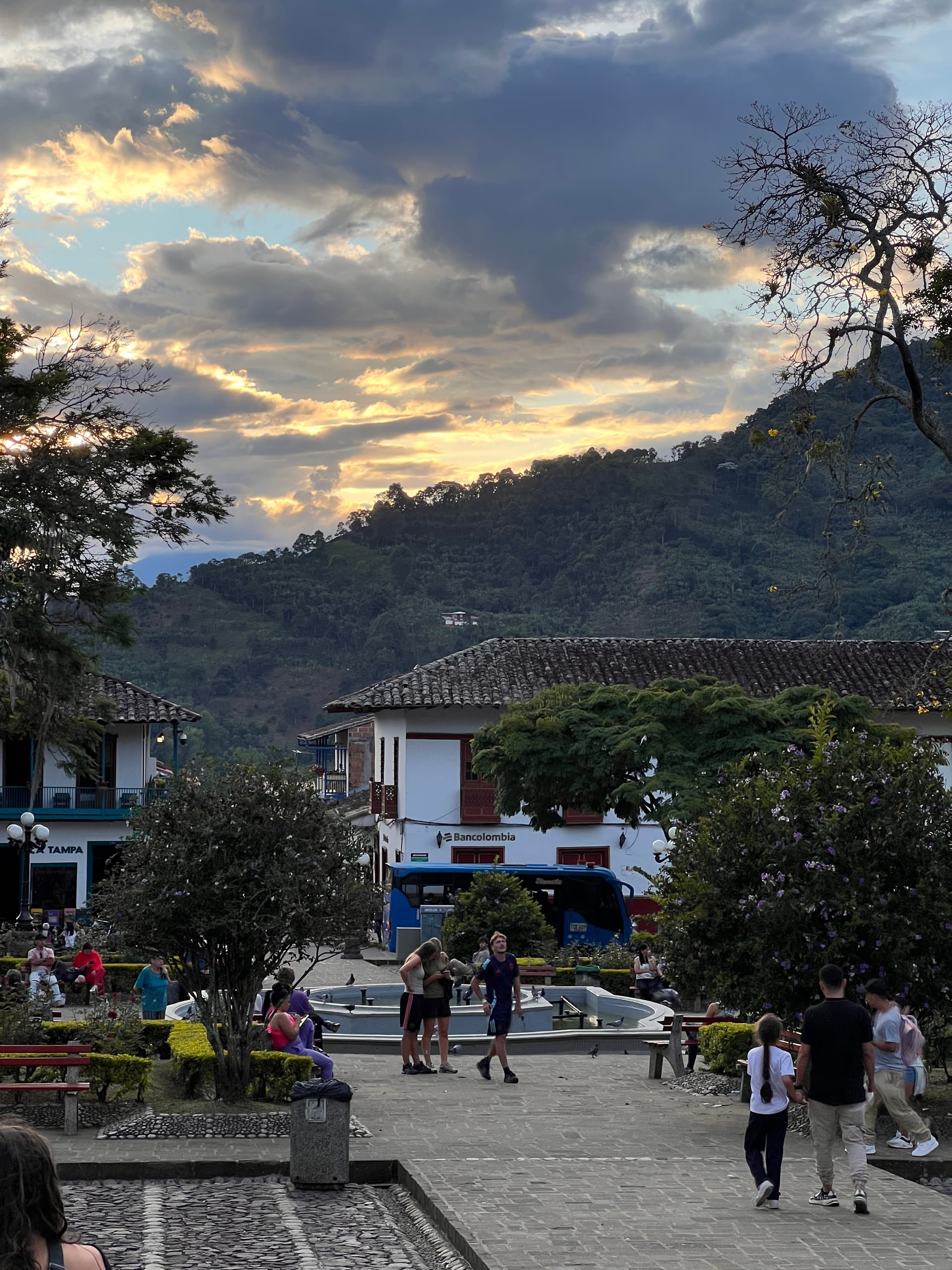
The best way to end this walking tour is to return to the plaza as evening settles over the valley. The mountains that ring Jardín catch the last light, turning purple and blue against a sky that shifts from gold to rose to deep indigo. The street lights come on — warm, yellow — and the facades, which have been blazing with color all day, soften into gentler tones. The doors, most of them closed now for the night, become quieter presences. Their colors are still there, but muted, intimate, as if the houses have turned inward for the evening.
Find one of the painted sillas in the plaza. Order a tinto or an aguardiente from one of the cafes along the square. Sit. Listen. The Basilica's bell might ring. A street musician might start playing. Families stroll. Friends greet each other with the unhurried warmth that defines social life in Antioquia's small towns.
And if you pay attention, you will notice that the plaza at night is framed, on every side, by doors. Closed doors, each one a different color, each one keeping safe the private life of a family, each one hand-carved and hand-painted and maintained with a care that amounts to love. Tomorrow morning, those doors will open again. The town will pour out into the streets. The light will return. The colors will blaze. And Jardín will do what it has done every day for more than 160 years — present itself to the world as a place where beauty is not an aspiration but a habit, not an exception but the rule, not something you visit but something you live.