Jardín's Basilica: The Story Behind the Church
Every town in Colombia has a church on the main square. It is practically a requirement of Colombian urbanism, a tradition stretching back to the colonial founding of each pueblo. But very few of those churches stop you in your tracks the way the Basílica Menor de la Inmaculada Concepción does when you first walk into Jardín's Parque El Libertador. Rising above the colorful facades and flowering balconies that line the square, the Basilica dominates the skyline with a presence that feels almost impossible for a town of this size — a soaring neo-gothic monument carved from local stone, planted firmly in the heart of the Andes at 1,750 meters above sea level.
This is not a modest village chapel. This is a cathedral-scale achievement built by the hands of local farmers, coffee growers, and artisans over more than two decades. The story of how it got here, why it looks the way it does, and what it means to the people of Jardín is one of the most fascinating threads in the town's history. Understanding the Basilica deepens every other experience you will have in this remarkable pueblo — from sipping coffee on the square to exploring the surrounding countryside.
Let's step inside.
The History: How a Mountain Town Built a Cathedral
The story of the Basilica begins in the late nineteenth century, when Jardín was still a young settlement. Founded in 1863, the town grew rapidly thanks to coffee cultivation and gold mining in the surrounding mountains. By the turn of the twentieth century, the original parish church — a modest wooden structure — was no longer adequate for the growing congregation. The people of Jardín wanted something grander, something that would reflect their faith and their ambitions for the town they were building in the clouds.
Construction of the current Basilica began in 1918 under the direction of Father Juan Nepomuceno Barrera, who envisioned a neo-gothic masterpiece that would rival churches in much larger Colombian cities. The ambition was audacious. Jardín was a remote mountain town reachable only by mule trails and unpaved roads. There were no cranes, no heavy machinery, no industrial supply chains. Every block of stone had to be quarried locally from the hills surrounding the town and transported by hand or by mule to the construction site.
The building campaign lasted from 1918 to 1942 — twenty-four years of continuous effort. The entire community participated. Farmers donated labor between harvests. Coffee growers contributed portions of their earnings. Women organized fundraising events and bazaars. Children carried smaller stones. The Basilica was not just a construction project — it was a communal act of devotion that united the town across generations. Grandparents who laid the first foundation stones watched their grandchildren help raise the spires.
The stone itself is one of the Basilica's most distinctive features. Rather than importing materials from distant quarries, the builders used a locally sourced stone that gives the church its characteristic grey-green color. This stone, pulled from the same mountains that surround Jardín, creates a visual harmony between the building and its landscape — the Basilica looks as though it grew directly from the Andean earth rather than being placed upon it.
When the church was finally completed and consecrated, it represented something far beyond religious architecture. It was proof that a small, isolated mountain community could achieve something extraordinary through collective will and sustained effort. That spirit of communal pride still permeates Jardín today, and locals speak of the Basilica with a reverence that goes beyond the spiritual — it is their shared masterpiece.
For more on how this history shaped the town you see today, read our complete history of Jardín.
The Architecture: Neo-Gothic in the Andes
The Basilica's architectural style is neo-gothic, a revival of the medieval European gothic tradition that was popular in Latin American church construction during the late nineteenth and early twentieth centuries. But while neo-gothic churches exist throughout Colombia and the wider continent, the Basílica de la Inmaculada Concepción stands out for the quality of its execution and the striking contrast between its European architectural vocabulary and its unmistakably Andean setting.
Exterior Details
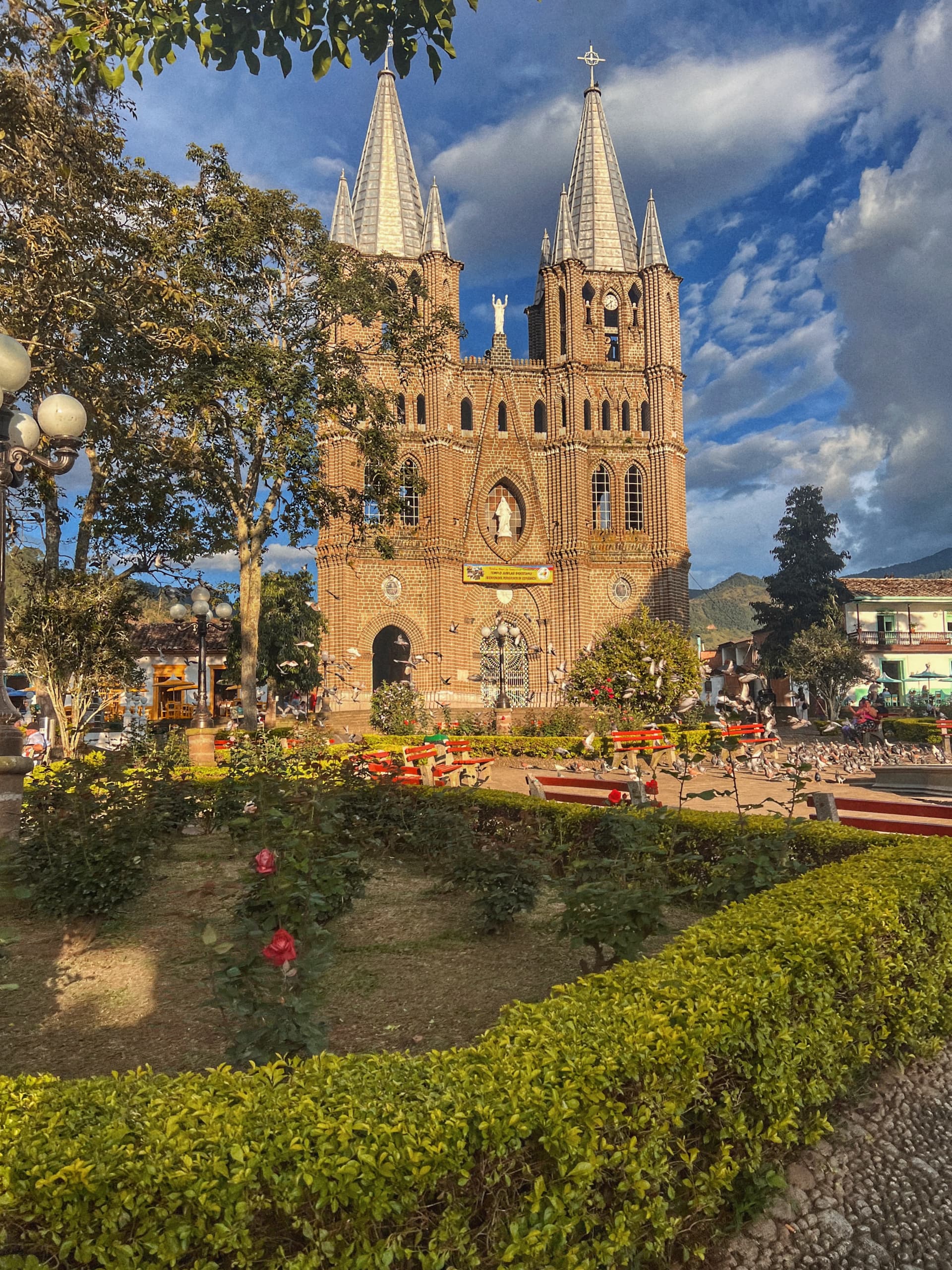
The facade is the first thing you encounter, and it rewards close inspection. Twin bell towers rise symmetrically on either side of the main entrance, tapering to pointed spires that pierce the mountain sky. The towers are adorned with slender lancet windows, pointed arches, and decorative tracery — all hallmarks of the gothic tradition, rendered here in the rough-hewn local stone that gives them a textural warmth absent from smoother European examples.
The main entrance portal features a large pointed arch framing heavy wooden doors. Above the doors, a rose window admits light into the nave. The roofline is punctuated by pinnacles and finials that create a jagged silhouette against the clouds that frequently drift through the valley. When mist rolls in from the surrounding mountains — which happens regularly, especially in the mornings — the upper portions of the towers disappear into white cloud, creating an ethereal effect that photographs beautifully.
The flying buttresses along the sides of the building are not merely decorative. They serve the same structural function as their medieval predecessors, transferring the lateral thrust of the vaulted ceiling outward and downward, allowing the walls to be thinner and the windows larger than would otherwise be possible. This engineering solution, developed in twelfth-century France, was faithfully replicated here in the mountains of Antioquia seven centuries later.
Scale and Proportions
The Basilica is approximately 50 meters long and its towers reach roughly 30 meters in height — dimensions that would be respectable for a church in a major city but are genuinely startling in a town where no other building exceeds two stories. The proportions are deliberately imposing. The architects understood that a neo-gothic church derives much of its emotional power from verticality — the eye is drawn upward, from the earthly to the heavenly. Walking through the front doors, you feel the full force of this vertical pull as the interior opens above you into ribbed vaulted ceilings that seem impossibly high for a building made of mountain stone.
The Interior: Light, Color, and Devotion
If the exterior of the Basilica impresses with its scale and stonework, the interior astonishes with its color and atmosphere. Stepping through the main doors from the bright Andean sunlight into the cool, dim nave is one of Jardín's most powerful sensory experiences.
Stained Glass Windows
The stained glass windows are the interior's crowning glory. Lining both sides of the nave and filling the rose window above the entrance, they depict scenes from the life of the Virgin Mary, the saints, and key moments in Christian theology. When sunlight streams through them — particularly in the late morning and early afternoon — the interior is flooded with pools of colored light that shift across the stone floor and wooden pews as the sun moves across the sky.
The windows were imported from Europe and represent a significant portion of the total construction cost. Their survival through decades of Colombian history, including periods of civil unrest and seismic activity, is something locals point to with particular pride. Each window tells a story, and spending fifteen or twenty minutes slowly walking the nave and reading the visual narratives is one of the most meditative things you can do in Jardín.
The Altars
The main altar is an ornate neo-gothic structure in carved wood, painted in rich colors and highlighted with gold leaf. At its center stands the statue of the Inmaculada Concepción — the Virgin of the Immaculate Conception — from which the Basilica takes its name. The altar's intricate woodwork echoes the stone tracery of the exterior, creating a visual continuity between inside and outside.
Side altars line the nave, each dedicated to a different saint and each featuring its own carved retable, candles, and devotional offerings. The craftsmanship of these altars reflects the same artisan tradition that still thrives in Jardín today — the town remains famous for its woodworking and cestería (basket weaving), and the hands that carved these altars passed their skills down through generations to the artisans working in town today.
The Atmosphere
Beyond the individual architectural and artistic elements, the interior of the Basilica has an atmosphere that is difficult to convey in words or photographs. The combination of cool stone, filtered colored light, the faint smell of incense and candle wax, and the near-total silence creates a space that feels genuinely set apart from the world outside. Even travelers who are not religious frequently describe spending time inside the Basilica as a profoundly calming experience.
The Plaza and Surrounding Area
The Basilica does not exist in isolation. It is the centerpiece of a carefully composed urban landscape that makes Jardín's main square one of the most beautiful in all of Colombia.
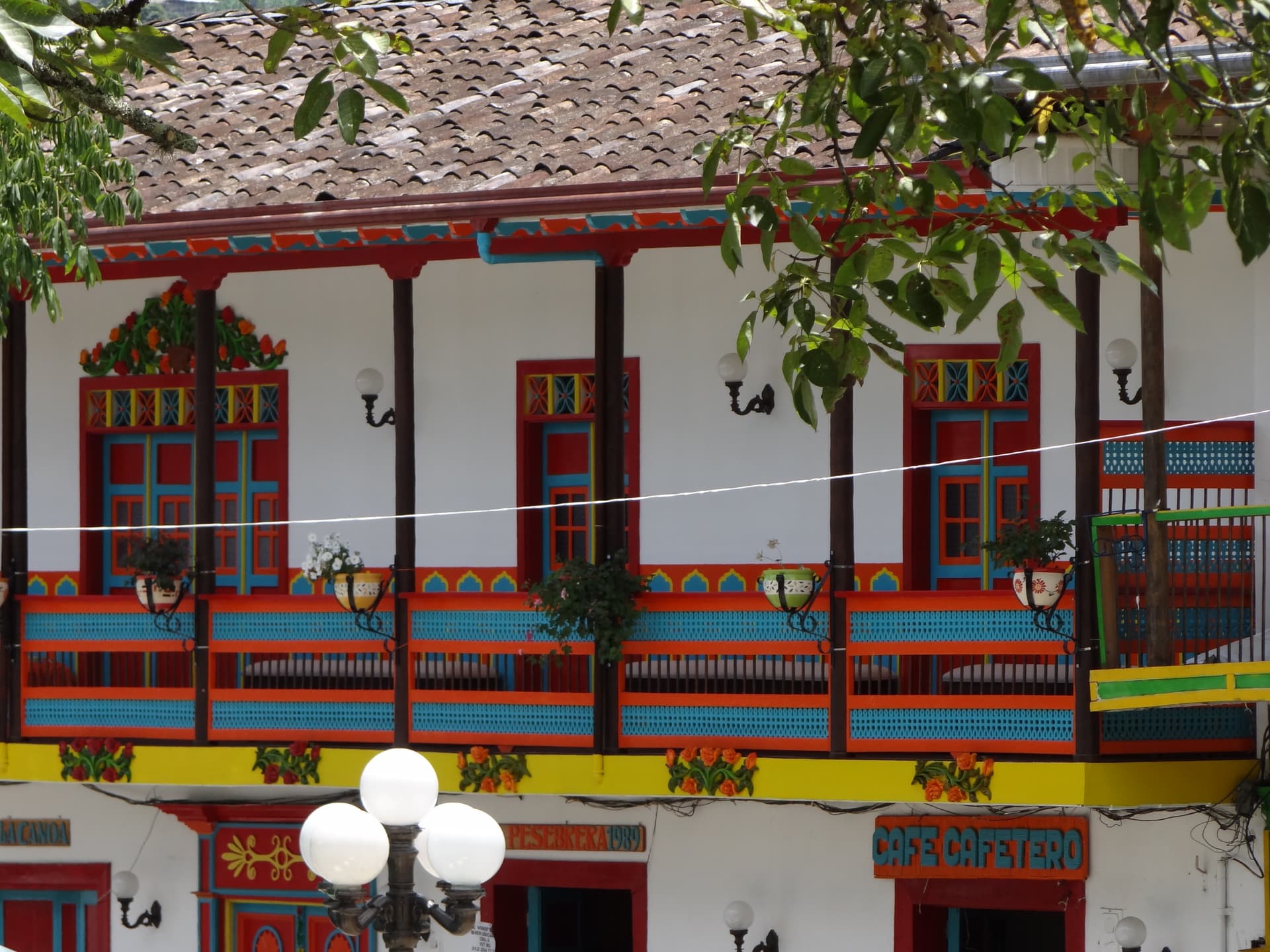
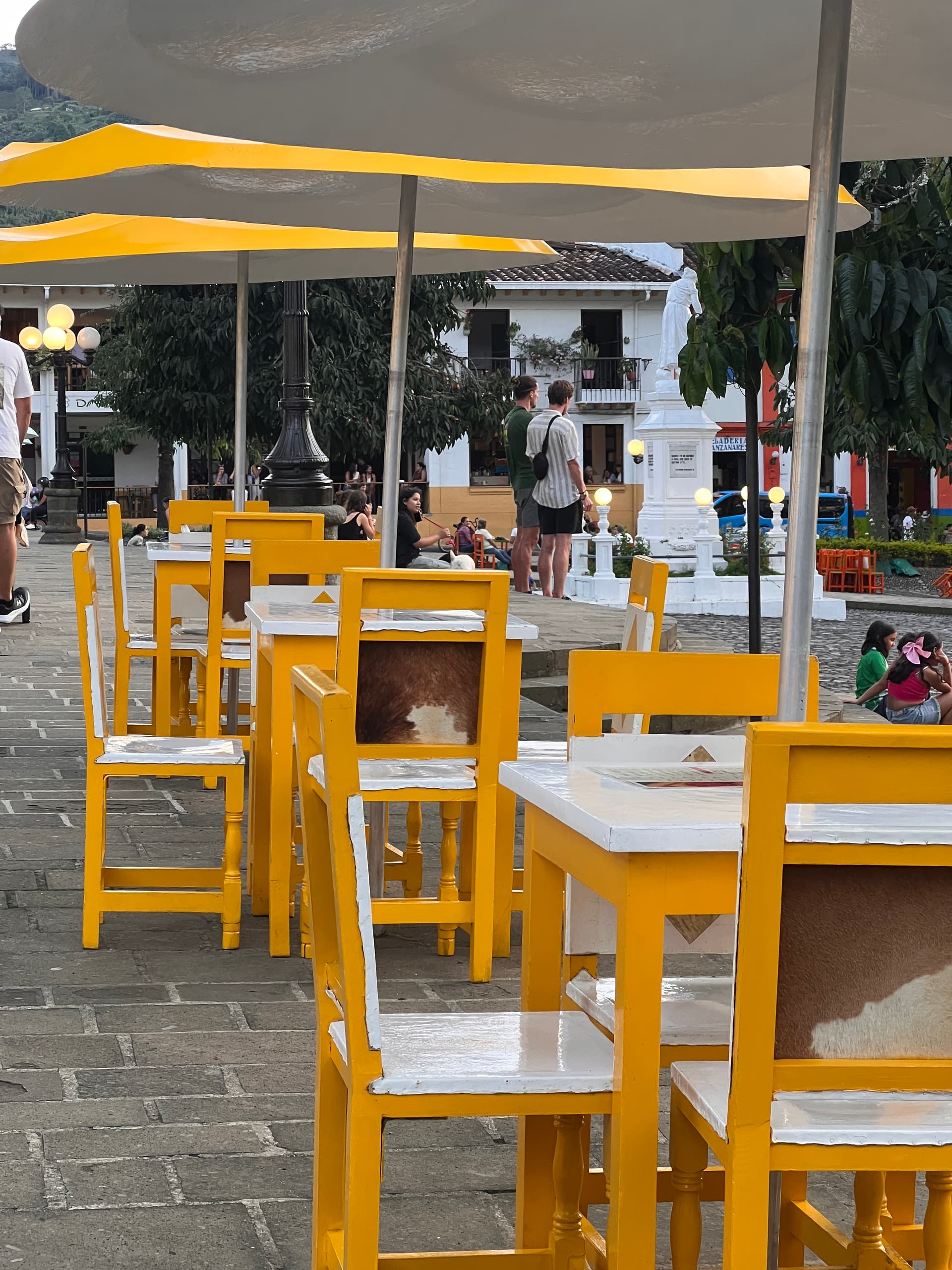
Parque El Libertador — the town's central plaza — stretches out before the Basilica's main entrance. The square is paved with stone and lined with two-story colonial buildings painted in bold primary colors: yellows, blues, greens, reds, and oranges. Every building has a balcony, and most of those balconies overflow with flowering plants. The effect is of a living painting, with the grey stone Basilica as the dramatic centerpiece anchoring the composition.
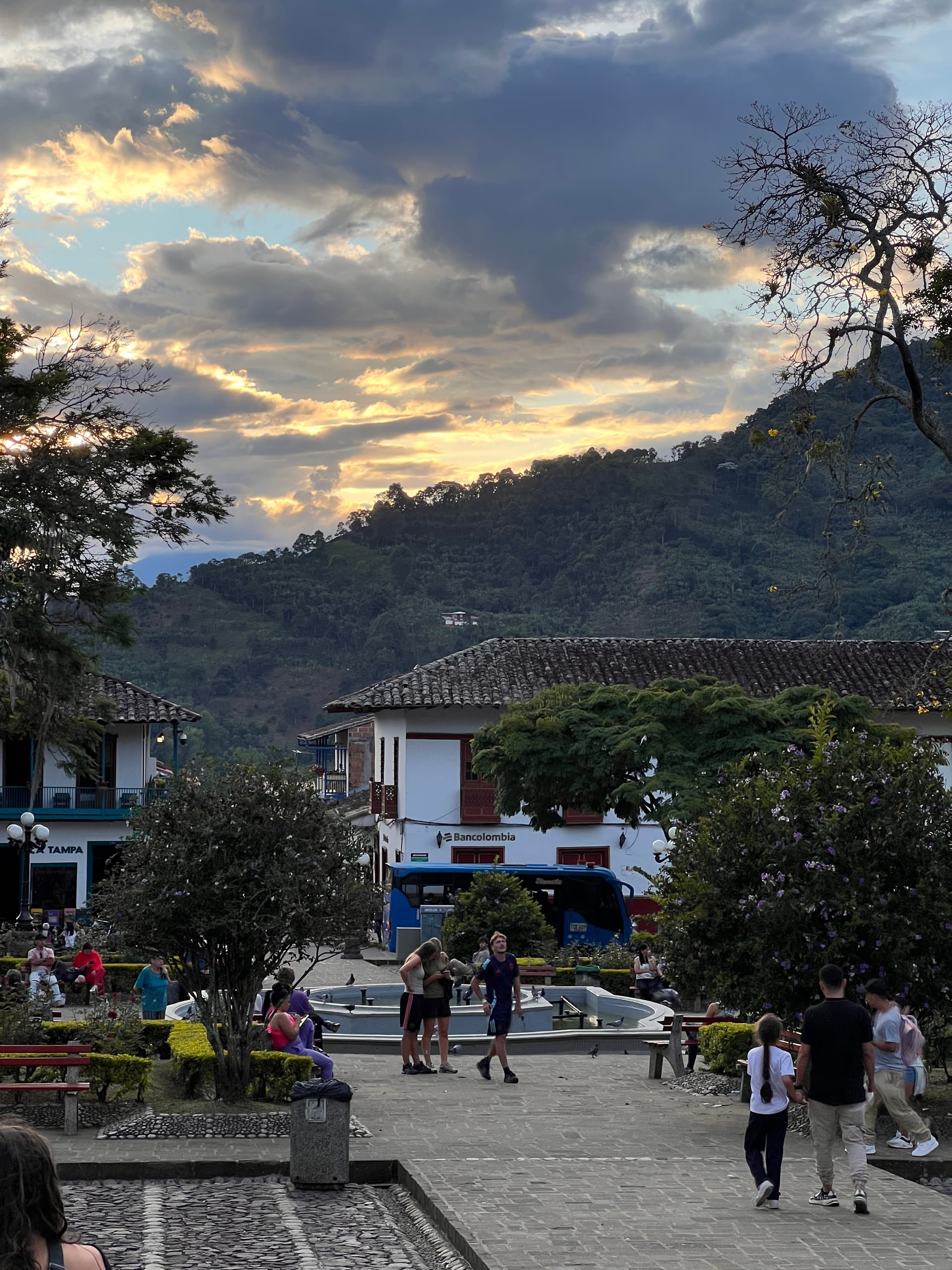
The plaza functions as Jardín's outdoor living room. In the mornings, retirees gather on the stone benches to drink tinto (black coffee) and discuss the news. In the afternoons, families stroll with children and dogs. In the evenings, the Basilica is illuminated by floodlights, and the entire square takes on a warm, golden glow that draws both locals and visitors to linger over dinner and drinks at the surrounding restaurants.
The relationship between the Basilica and the plaza is symbiotic. The church gives the square its grandeur and its focal point. The square, in turn, gives the church context and community — this is not a monument preserved behind barriers and admission fees, but a living building embedded in the daily life of a real town.
Pro tip: Base yourself at Isla de Pascua — The Basilica faces the main square — visible from Isla de Pascua every day.
Visiting Tips
Mass Schedule
The Basilica holds regular masses throughout the week, with the principal Sunday mass drawing the largest congregation. Attending a mass, even as an observer, is a remarkable cultural experience — the church fills with families in their Sunday best, the organ reverberates through the stone vaults, and you witness the building functioning as it was intended to function. Mass times vary seasonally, so ask at your accommodation or check the notice board outside the church for the current schedule.
Photography
The Basilica is one of the most photogenic buildings in Antioquia, and photographing it well is half the pleasure of visiting. A few tips for getting the best shots:
Exterior: The best light on the facade occurs in the late afternoon when the setting sun warms the stone and creates dramatic shadows in the carved details. For a classic composition showing the Basilica rising above the colorful plaza buildings, position yourself at the far end of the square and shoot with a wide-angle lens.
Interior: Bring a camera that handles low light well, or use a tripod. Flash photography is generally discouraged out of respect for worshippers. The stained glass windows photograph best between 10 AM and 2 PM when direct sunlight passes through them.
From above: For an aerial perspective, hike up to the Cristo Rey statue on the hill above town. From there, you can see the Basilica in relation to the surrounding town and mountains — a shot that captures the extraordinary contrast between this grand church and the small pueblo that built it.
Dress Code
While Jardín is informal by nature, the Basilica is an active place of worship. Visitors should dress respectfully — cover your shoulders and knees, remove hats when entering, and keep your voice low. This is not strictly enforced for tourists during non-mass hours, but observing these courtesies shows respect for the community.
Access
The Basilica is open to visitors daily. There is no admission fee. The building is wheelchair accessible at the main entrance level, though the side aisles and some areas may be challenging for mobility-impaired visitors due to the uneven stone flooring.
Cultural Significance
The Basílica de la Inmaculada Concepción is more than Jardín's largest building. It is the physical manifestation of the town's identity. When locals describe what makes Jardín special — what distinguishes it from the hundreds of other small pueblos scattered across the Colombian Andes — the Basilica is invariably part of the answer.
The church represents continuity in a country where change has often been violent and disruptive. While Colombia endured civil wars, drug conflicts, and economic upheaval throughout the twentieth century, the Basilica remained. It stood through La Violencia of the 1950s, through the narco years of the 1980s and 1990s, and through the peace process of the 2010s. For each generation of jardinenos, the church has been a constant — the one thing that never changed when everything else did.
This is partly why the Basilica draws such fierce local pride. It was built by the community, belongs to the community, and continues to serve the community. It is not a tourist attraction that happens to be a church — it is a church that happens to attract tourists. Understanding this distinction is important for visitors. When you admire the architecture and photograph the stained glass, remember that you are standing in a space that is deeply meaningful to the people who live here.
Events and Festivals at the Basilica
The Basilica serves as the spiritual anchor for Jardín's major festivals and religious celebrations throughout the year. These events transform the church and surrounding plaza into vibrant communal gatherings that blend Catholic tradition with Antioquian culture.
Semana Santa (Holy Week)
Easter week is the most important religious observance of the year. Processions depart from the Basilica carrying elaborately decorated floats bearing statues of Christ and the saints through the streets of town. The entire community participates, and the atmosphere is solemn and deeply moving. If you visit during Semana Santa, expect the town to be crowded but the experience to be unforgettable.
Fiestas de la Rosa
Jardín's signature festival celebrates the town's flower-growing tradition, and the Basilica plays a central role. The church is decorated with elaborate floral arrangements, special masses are held, and the plaza fills with music, food vendors, and dancing. The festival typically takes place in May, around the town's founding anniversary, and draws visitors from across Antioquia.
Fiestas del Retorno
This homecoming festival, usually held in late December, welcomes back jardinenos who have moved to Medellín and other cities. The Basilica hosts special masses for the returning families, and the town swells with people reconnecting with their roots. The plaza becomes a massive outdoor gathering where multiple generations share food, music, and stories.
Día de la Inmaculada Concepción
December 8th is the feast day of the Immaculate Conception — the Basilica's patron saint. This is perhaps the most spiritually significant day of the year for the church itself. Special masses, processions, and devotions mark the occasion, and the building is decorated with candles and flowers. Attending the evening celebration, when the candlelit interior glows with a golden warmth, is one of Jardín's most beautiful experiences.
Final Thoughts
The Basílica de la Inmaculada Concepción is the soul of Jardín. It anchors the town's physical layout, its cultural identity, and its sense of collective memory. Whether you are an architecture enthusiast analyzing the flying buttresses, a photographer chasing the perfect light through stained glass, a history buff piecing together the story of its construction, or simply a traveler sitting quietly in a pew absorbing the atmosphere, this building offers something profound.
Take your time with it. Visit more than once — the Basilica reveals different aspects of itself at different times of day and in different weather. Morning mist, afternoon sun, evening floodlights, and rainy-day gloom each transform the experience. And when you sit in the plaza afterward with a coffee, looking up at those stone towers rising above the colorful facades, you will understand why the people of Jardín spent twenty-four years building something this beautiful in the middle of the mountains.
For more on Jardín's rich cultural heritage, explore our complete travel guide or plan your visit with our 3-day itinerary. And if the artisan traditions of the town interest you, do not miss our guide to cestería and traditional crafts.